
The French Highway Code does not set an abstract number of people allowed on a motorcycle. The answer depends on a specific document: the vehicle registration certificate, which indicates the number of seats provided by the manufacturer during approval. For a classic motorcycle without a sidecar, this number is almost always limited to two, including the rider.
Motorcycle Approval and Number of Seats: What the Registration Certificate Says
Section S.1 of the registration certificate indicates the number of seating places of the vehicle. On a motorcycle without a sidecar, there are two configurations: solo approval (one seat) or two-seater (two seats). A motorcycle approved as solo strictly prohibits carrying a passenger, even if a rear seat is physically present.
In practice, the legal limit is not “two people by principle.” It corresponds to the number of seats provided during the vehicle’s reception by the manufacturer. Exceeding this number constitutes an offense, punishable by a fine and points deduction. To check the status of a used motorcycle, simply consult the registration certificate: if it states “1 seat,” no passenger can ride, period.
This approval logic also applies to all motor vehicles. For quadricycles, for example, it is the same section S.1 that is authoritative. To know the number of seats on a motorcycle without a sidecar or with a sidecar, the registration certificate remains the only reliable reference.
Mandatory Equipment for Carrying a Motorcycle Passenger
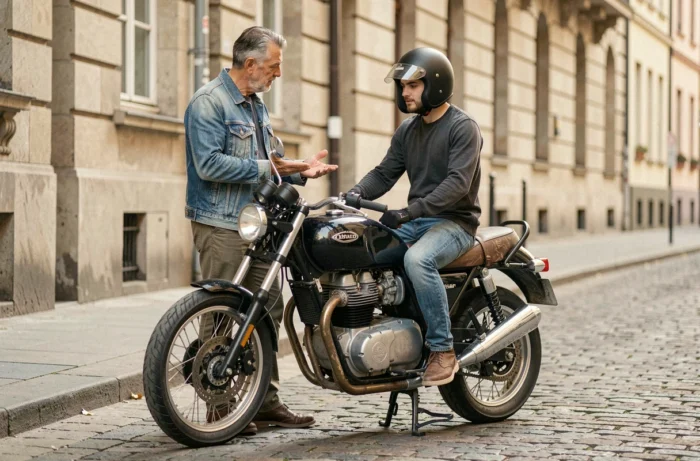
Being approved for two passengers is not enough. The motorcycle must have specific equipment for carrying a passenger to be legal. The absence of any of these elements can lead to a fine, even if the registration certificate does indicate two seats.
Here are the required equipment for the passenger:
- A permanently fixed passenger seat, distinct from that of the rider or forming a clearly identifiable extension
- Passenger footrests on each side of the motorcycle, securely attached to the frame
- Hand grips or a strap allowing the passenger to stabilize themselves
A certified helmet is mandatory for both the rider and the passenger. Since November 2016, CE-certified gloves are also required for anyone riding on a motorized two-wheeler, including both the rider and passenger. This obligation is often unknown to occasional passengers.
The high-visibility vest must be accessible on board in case of an emergency stop, but wearing it is only mandatory when immobilized on the roadway or its surroundings.
Transporting a Child on a Motorcycle: Minimum Age and Conditions
The issue of child passengers generates a lot of confusion. No minimum legal age is set by the Highway Code for riding on a motorcycle as a passenger. However, a physical condition applies: the child must be able to reach the footrests and wear a certified helmet suitable for their morphology.
A child whose feet do not touch the footrests cannot be transported legally. This requirement effectively eliminates very young children, even though no text explicitly mentions a minimum age. The child’s height thus becomes the determining criterion.
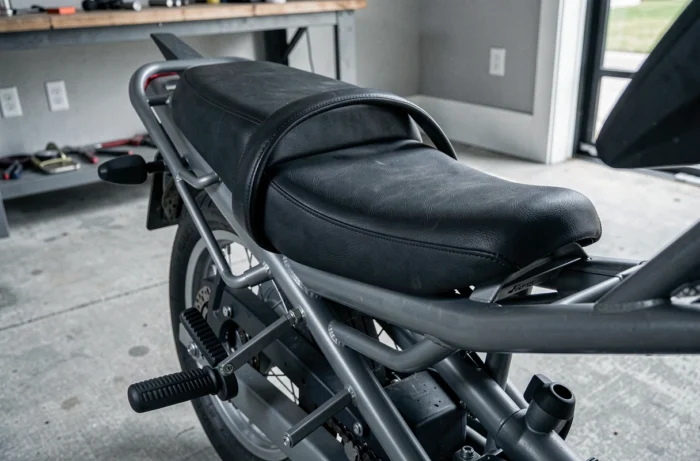
Law enforcement assesses the situation on a case-by-case basis. A small child seated on a sports motorcycle, with their feet dangling, exposes the rider to a fine. Conversely, a child able to place their feet on the footrests, wearing a helmet and certified gloves, meets the regulatory conditions.
The child seat for motorcycles has no official approval framework in France. Some commercial accessories allow for raising a child, but their use does not exempt from adhering to the footrest and helmet condition. Field feedback varies on the actual safety effectiveness of these devices.
Motorcycle Insurance and Passenger: Check Coverage
Transporting a passenger engages the civil liability of the rider. Third-party insurance covers bodily injuries of the passenger in case of an accident, as they are considered a third party. However, the rider themselves is only covered if they have taken out an individual accident guarantee or a comprehensive policy including this protection.
Some motorcycle insurance policies exclude the transport of passengers on vehicles approved for solo use. Transporting someone on a motorcycle not intended for this use can result in a denial of compensation in the event of a claim, in addition to the traffic offense.
Before regularly taking a passenger, checking the conditions of their insurance contract can prevent an unpleasant surprise. Insurers sometimes require a specific declaration for the habitual transport of passengers, without additional cost in most cases.
Sanctions for Overloading or Non-Compliance with Approval
Riding three on a motorcycle approved for two passengers, or two on a motorcycle approved for solo use, constitutes an offense under the Highway Code. The fixed fine is 35 euros for exceeding the number of passengers, but the indirect consequences are more severe.
In the event of an accident, overloading can be considered an aggravating circumstance. The insurer may invoke an exclusion of coverage if the number of passengers exceeds that provided by the approval. The rider then becomes personally liable for all damages, including bodily injuries.
The absence of a helmet for the passenger is punishable by a fourth-class fine and a deduction of three points from the rider’s license. The absence of certified gloves results in a third-class fine for each person involved.
In summary: on a motorcycle without a sidecar, two people maximum if the approval allows it, one only otherwise. The registration certificate decides, the equipment complements, and the insurance wraps up the arrangement. Any configuration deviating from this framework exposes the rider to sanctions and, above all, to considerable financial risk in the event of a claim.