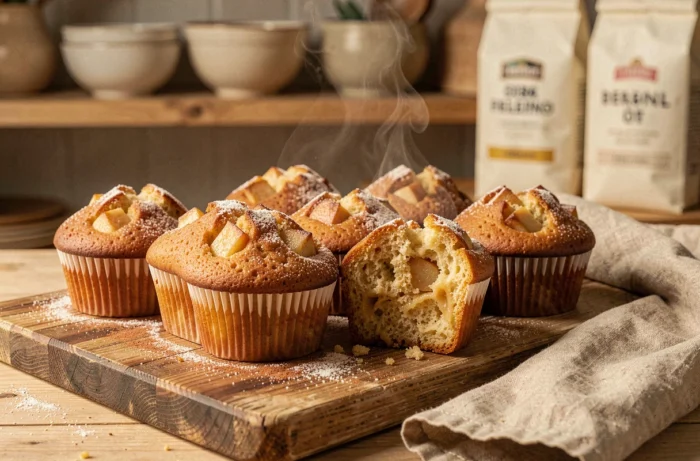
Apple muffins are among the most searched-for snack recipes online, and Cyril Lignac’s name is often associated with them. Several blogs and cooking groups share a version attributed to the chef, though they do not always cite an official source, such as a TV show or cookbook.
This recipe appears in several variations, but they share a common foundation: a lightly mixed batter, apples cut into small cubes, and careful baking. Here’s what really makes the difference between a moist muffin and a dense one, beyond simply following a list of ingredients.
Apple muffin batter: why minimal mixing makes all the difference
The most important technique for making successful muffins has nothing to do with the choice of pan or brand of flour. Stop mixing as soon as the flour is no longer visible—this is advice shared by several specialist sources, from Airzen to Cuisine Actuelle. This simple step prevents the gluten in the wheat flour from forming an overly tight network, which would make the crumb dense and rubbery.
In practice, the batter should remain slightly lumpy. It’s common to try to smooth it out as you would for a cake, but muffins follow the opposite logic. The recipe attributed to Cyril Lignac is based on this principle, which also makes it easy to follow: the less you work the batter, the better the result.
The Cyril Lignac apple muffins shared on blogs generally use a base of wheat flour, granulated sugar, baking powder, milk, and oil. Using oil instead of melted butter also helps create a moister texture, since oil stays liquid at room temperature and keeps the crumb hydrated for longer.
Choosing and cutting the apples: factors that affect texture
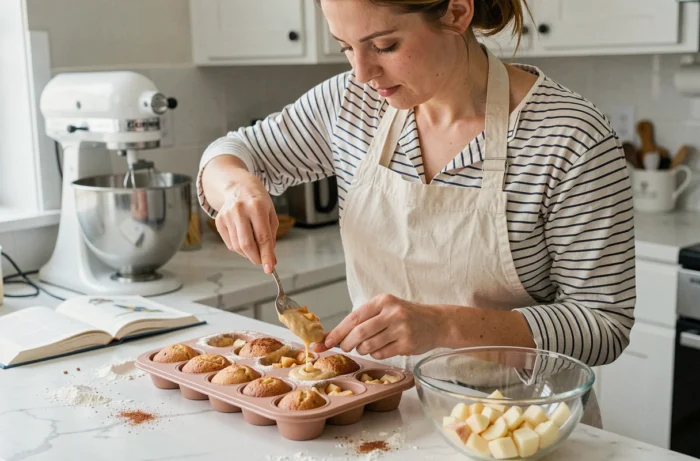
Not all apples behave the same way when baked. Airzen recommends firm-fleshed apples cut into small cubes, so the pieces cook without releasing too much juice into the batter. An apple that breaks down too easily (such as an overripe Golden) releases excess water, making the bottom of the muffin soggy.
Evenly sized cubes of about one centimeter help the muffins bake uniformly. Pieces that are too large remain raw in the center while the surrounding batter is already cooked. Cuisine Actuelle confirms this approach: consistent cutting has a direct impact on the final result.
Cinnamon, often mentioned in variations of this recipe, does more than add flavor. Paired with apple, it creates a contrast that balances the sweetness of the batter. One teaspoon is enough to add fragrance without overpowering the other flavors.
Apple varieties to choose for muffins
- Firm-fleshed varieties that hold their shape when baked, such as Granny Smith or Braeburn, leave distinct pieces in the crumb.
- Naturally sweet varieties let you slightly reduce the amount of sugar in the batter, bringing out the fruit’s flavor.
- Tart apples provide a welcome balance to the sugar and cinnamon, keeping the flavor from becoming too one-note.
Baking muffins: temperature and filling the pan
Baking is where a successful muffin stands apart from a failed one. Fill the muffin cups two-thirds full to give the batter room to rise without spilling over, forming the characteristic dome. An overfilled pan produces muffins that spread out, while underfilled cups result in dry, flat muffins.
Most versions of the recipe call for about 20 minutes of baking. The toothpick test is still the most reliable way to check for doneness: inserted into the center, it should come out with a few moist crumbs, but no wet batter. Removing the muffins from the pan a few minutes after taking them out of the oven prevents residual steam from softening the bottoms.
Common baking mistakes
Opening the oven door during the first ten minutes causes a sudden temperature drop that prevents the muffins from rising. The leavening agent needs steady heat to work properly. Another pitfall is an oven that hasn’t been preheated properly. If it hasn’t reached the right temperature when the muffins go in, the chemical leavening process starts too slowly and the muffins stay flat.
The choice between a silicone pan and a metal pan matters, too. Metal conducts heat more effectively, helping create a light crust around the edges. Silicone provides gentler baking, sometimes too gentle: the muffins may not hold their shape when removed from the pan.
Storing apple muffins: how to keep them moist
Apple muffins are at their best in the hours after baking. The moisture released by the apples makes them go stale faster if they aren’t stored properly. At room temperature, in an airtight container, they keep well for one to two days.
For longer storage, freezing works well. Freeze the muffins individually, wrapped in plastic wrap, then reheat them for a few seconds in the microwave or for a few minutes in a low oven. Their texture will be close to freshly baked, as long as you don’t let them dry out in a poorly sealed freezer bag.
Recipe attributed to Cyril Lignac: what the sources show
The versions shared online have a common base: flour, sugar, baking powder, milk, oil, apples, and cinnamon. The proportions vary from blog to blog, raising questions about how closely they follow an original recipe. None of the available results point to an identifiable primary source that definitively confirms the attribution.
That doesn’t take away from the quality of the recipe itself. Its core techniques—minimal mixing, finely diced apples, and careful baking—are based on tried-and-tested baking principles, regardless of whose name is attached to it. Follow them carefully and you’ll get a moist, fragrant muffin that requires neither special equipment nor prior experience.
The next time you make these muffins, focus on two things: stop mixing before the batter is smooth, and cut the apples into evenly sized cubes. The rest will fall into place.