The community of communes of the Rhine is not limited to an administrative perimeter. Its recent projects reflect technical decisions on industrial conversion, aquatic environment management, and cross-border cultural development, with concrete implications for the planning of the Alsatian territory.
Project Declaration and Compatibility Adjustment of the PLU of Fessenheim
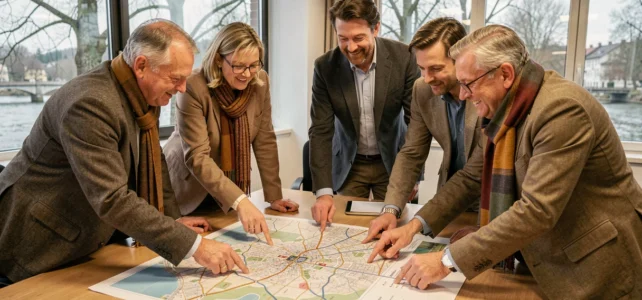
The closure of the Fessenheim Nuclear Power Plant has triggered a cascade of urban planning procedures rarely visible in mainstream media. The project declaration involving the compatibility adjustment of the PLU of Fessenheim serves as the central legal lever to enable the site’s conversion.
This mechanism, provided for by the urban planning code, allows the intercommunal authority to modify land use rules without waiting for a complete revision of the document. In practical terms, this means that parcels previously classified as nuclear industrial zones can accommodate new purposes, including the EcoRhena business park.
The sale of EcoRhena land to Liebherr, covering several dozen hectares, confirms the renewed attractiveness of post-nuclear land. We observe that the CC Rhin is structuring its land offer around a lot commercialization logic, targeting large industrial groups capable of absorbing significant land areas.
The enhanced consultation conducted at the intercommunal level in 2026 also reflects a desire not to let peripheral municipalities suffer the effects of spillover without consultation. The annexes of the PLUs of several neighboring municipalities (Artzenheim, Balgau, Biesheim, Nambsheim, among others) have been subject to a coordinated update.
Art’Rhena+: Cross-Border Cultural Structuring on the Upper Rhine
The Art’Rhena+ project goes beyond a simple cultural animation program. Over the period 2024-2027, it aims to transform the Art’Rhena facility into a structuring cultural hub of the Upper Rhine, with shared governance between French and German partners.
The Alsace Rhin Brisach Community of Communes is leading the initiative in partnership with the City of Breisach am Rhein, the Eurodistrict, and the OLCA. This cross-border partnership setup is not cosmetic: it conditions access to Interreg funding, which remains the main co-financing lever for bilateral cultural projects on the Rhine.
One of the project’s most technical objectives concerns the stabilization of financial aid to artists beyond the program’s duration. This point distinguishes Art’Rhena+ from classic event-based initiatives. The challenge is to create a sustainable support mechanism for local cultural sectors, independent of European subsidy cycles.
North Rhine Island: Integrated Tourist Development
The tourist component is articulated with Art’Rhena+ without being confused with it. The development of North Rhine Island includes the creation of docking facilities for river cruise boats and a shared forecourt along the Alsace Canal. These infrastructures position the territory in the growing segment of river tourism along the Rhine axis.
GEMAPI and Economic Bicycle Path: Two Infrastructure Projects to Watch
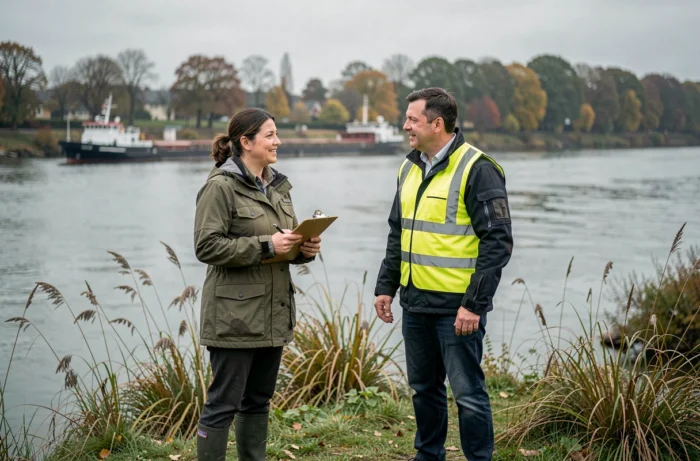
The GEMAPI competence (management of aquatic environments and flood prevention) represents a significant budget item for the Rhine-side intercommunalities. It covers the maintenance of dikes, combating erosion, and coordinating flood prevention actions.
We recommend monitoring the evolution of this competence in the Rhine context, where hydraulic issues are amplified by the proximity of the river and the density of the canal network. Coordination with the Living Rhine Plan, which brings together stakeholders along the Rhine for ecological restoration, adds a layer of institutional complexity.
The project for a so-called “economic” bicycle path addresses the need for access to the northern industrial-port areas along departmental road 52. The stated goal is to connect all businesses and industries in the area to a structured cycling network for the several thousand employees who work there daily.
- The path aims for comprehensive service to the northern industrial sites, not only the major employers but also the network of SMEs along RD 52.
- The route incorporates road safety constraints related to heavy truck traffic on this axis, complicating the chosen cross-section profile.
- The phasing of the work, already underway, plans for delivery in sections to maintain site accessibility during construction.
Territorial Marketing and Post-Fessenheim Attractiveness
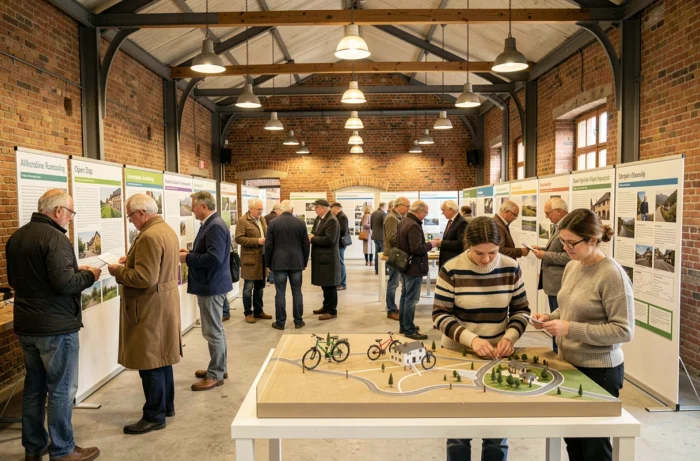
The name change to Alsace Rhin Brisach Community of Communes, effective since 2023, is part of a deliberate territorial marketing strategy. The goal is to dissociate the territory’s image from the sole nuclear power plant and attract new investors to the released land.
This strategy is based on three operational pillars:
- Active marketing of the EcoRhena park, with an initial tangible result (sale to Liebherr) serving as a reference for subsequent prospects.
- Development of river and cultural tourism, through Art’Rhena+ and the developments on North Rhine Island, to diversify the economic base.
- Investment in soft mobility infrastructures, which meets companies’ expectations regarding CSR and salary accessibility.
The territory also plays a less visible card: the coordinated update of urban planning documents across all member municipalities. This regulatory harmonization facilitates the processing of permits and reduces timelines for industrial or commercial project proponents.
The post-Fessenheim trajectory remains closely monitored by regional economic stakeholders. The success of the conversion will depend less on announcements than on the intercommunal authority’s ability to maintain a sustained pace of land marketing while preserving the ecological coherence imposed by the GEMAPI competence and the commitments of the Living Rhine Plan.