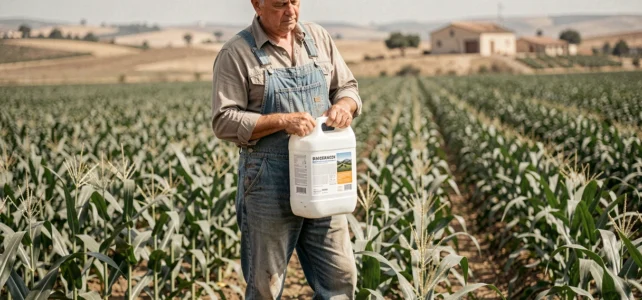
The five-liter can purchased from a Spanish agricultural cooperative or a border DIY superstore remains the most common format for French individuals attempting the operation. The price per liter is significantly lower than what glyphosate cost in France before its withdrawal from sale to non-professionals. The temptation is real, but the regulatory framework on both sides of the border has evolved considerably, including in 2026.
Carné de aplicador and phytosanitary register: the Spanish system that buying guides ignore
Spain allows the sale of glyphosate, but not in an administrative void. For formulations classified for professional use, the buyer must hold a carné de aplicador, the Spanish phytosanitary booklet. This document is not just a simple professional identity card.
The holder is required to maintain an operational register for each treatment carried out. This register must include the exact commercial name of the product, its market authorization number, the treated plot, the applied dose, and the application date. Every phytosanitary treatment must be recorded with the product’s AMM number.
A French individual who buys a five-liter can while presenting themselves as a professional, without being integrated into this traceability system, finds themselves in a regulatory inconsistency from the point of sale. Some retailers do not verify anything. Others ask for the carné. The ambiguity benefits the occasional buyer, but it does not provide legal protection.
We observe that most online content summarizes the Spanish situation as “free sale without certification.” This is inaccurate for professional concentrations, which precisely represent the most sought-after formats for purchasing glyphosate 5 liters in Spain at a lower cost.
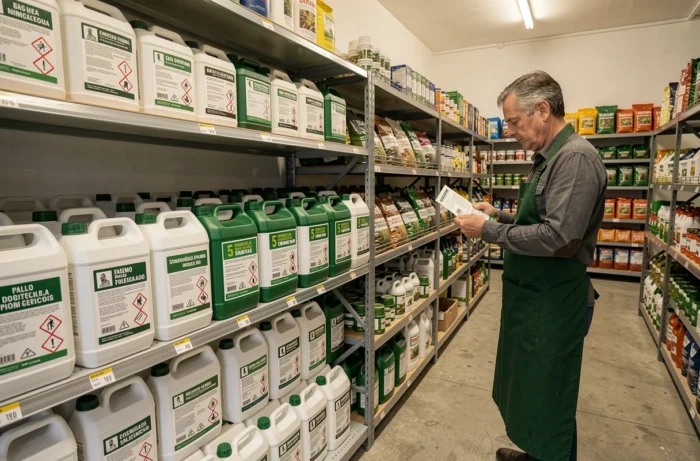
European renewal 2033 and new marketing conditions
The extension of glyphosate authorization at the European level until December 2033 does not imply a regulatory status quo. The harmonized marketing conditions were adjusted in 2026, with strengthened requirements on formulations authorized for sale and their monitoring.
Specifically, marketed products must meet updated composition and traceability criteria. A can purchased in Spain may contain a formulation perfectly compliant with European regulations, but this does not change its status under French law: importation by an individual remains prohibited.
What the European regulation does not cover
The regulation governs the approval of the active substance and sets guidelines for member states. It does not create a right for individuals to purchase across borders. Each country retains control over its national marketing authorizations. A product sold legally in Irun or Figueres has no value as a French AMM.
Importation to France: criminal qualification and real penalties
Bringing glyphosate back from Spain constitutes an offense under the rural code and the customs code. Competing articles often mention theoretical fine amounts. We recommend distinguishing two levels of risk based on the volume transported.
- For a single can detected during a roadside or customs check, the qualification is generally a fifth-class offense, with confiscation of the product and a fine of a few hundred euros for a first-time offender.
- For larger volumes or organized resale, the qualification shifts to a felony. The case judged at the end of 2023 in Castres illustrates this shift: an entrepreneur based in the Spanish Basque Country was buying glyphosate (brands Glifae, Radikal) to resell on platforms like eBay or Rakuten to French individuals. The OFB had detected this trafficking as early as 2020.
- Confiscation of the product is systematic, regardless of the volume. The can will not be returned to you, even if you have not yet crossed the border with the intention of using it in France.
Checks remain infrequent on border routes, which fuels a sense of impunity. The OFB and customs focus more on organized flows (postal shipments, online sales) than on isolated individuals. The risk per trip is low, but the penalty in case of a check is certain and non-negotiable.
Product concentration and real effectiveness: the calculation that no one makes
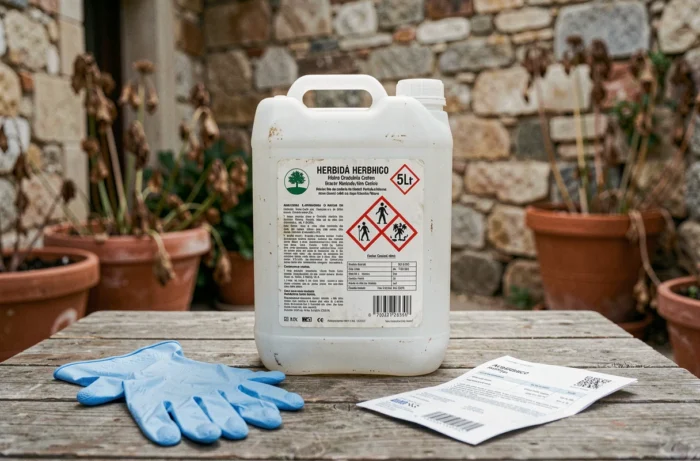
The five-liter cans sold in Spain come in several concentrations of active ingredient. Formulations intended for the general public hover around 36% glyphosate acid. Professional versions go significantly higher.
An individual who purchases a concentrated formulation without knowing the appropriate dilution rate for their soil, the treated area, and the growth stage of the weeds will either under-dose (poor results, rapid regrowth) or over-dose (soil contamination, leaching into groundwater). In both cases, the supposed value-for-money of the Spanish can collapses.
Formulations and co-formulants
The active ingredient alone does not determine a product’s toxicity. The co-formulants present in some Spanish formulations may differ from those that were authorized in France before 2019. Some adjuvants improve leaf penetration but increase aquatic toxicity. Without a safety data sheet read and understood, the user does not know what they are actually spraying.
The five-liter format, often presented as an economic advantage, far exceeds the needs of a domestic garden. An individual treating a few dozen square meters of driveway will store an opened can for years, with risks of product degradation and container leakage.
The savings made at purchase do not compensate for the legal risk, the environmental cost of over-dosing, or the difficulty of storing a volume unsuitable for domestic use. For a professional integrated into the Spanish traceability system, the question arises differently, but this is not the typical profile of the border buyer.