
When purchasing an old property, notary fees are paid based on the price of the property. However, the fitted kitchen, built-in dishwasher, or extractor hood are not load-bearing walls. These movable elements can be excluded from the calculation of transfer duties, provided that a precise formalism is followed from the sales agreement.
Fixed elements or removable furniture: the boundary that changes everything
We often encounter the same shortcut: “the fitted kitchen is deductible from notary fees.” In practice, only removable elements or those comparable to furniture are deductible. A granite countertop sealed to the wall, a backsplash tile, or a masonry storage column remain incorporated elements of the property. They are considered part of the real estate in a fiscal sense.
What changes the game is the real possibility of removing the element without degrading the property. A built-in oven can be unplugged and removed from its cabinet. An American refrigerator placed in a niche can also be removed. Anything that can be disassembled without renovation is considered deductible furniture.
The same principle applies throughout the entire property. Non-sealed bathroom furniture, removable shelves, and detachable light fixtures follow the same logic as the kitchen. As detailed by Le Top Immobilier, the distinction between furniture and real estate by destination conditions the entire deduction process.

Fitted kitchen and notary fees: preparing a file that the notary accepts
The notary has no obligation to accept a fanciful list. In 2026, the burden of proof lies with the buyer and the seller: concrete documents must be produced to justify each line of furniture deducted from the sale price.
Documents to gather before the sales agreement
The list of furniture must be attached to the promise or sales agreement, not added at the last moment at the notary’s office. Each item is listed with its description, condition, and estimated value. Purchase invoices are the strongest proof.
- Precise description of each item (brand, model, dimensions if relevant) with mention of the year of acquisition
- Application of a depreciation coefficient consistent with the age and actual wear of the equipment
- Original purchase invoices or, failing that, a reasoned estimate validated by the notary before signing
Without an invoice, the deduction remains possible but is more fragile in case of an audit. Some notaries accept a reasonable estimate if it corresponds to second-hand market prices. Feedback on this point varies among notarial offices.
The issue of valuation
Overvaluing the furniture to artificially inflate the deduction is a real risk. The tax administration can reclassify the transaction if the declared value of the furniture seems disproportionate compared to the overall price of the property. A kitchen installed eight years ago is not worth its original purchase price.
The value retained must remain consistent with the condition, age, and second-hand price of the items. A progressive discount is generally applied: a five-year-old appliance loses a significant part of its initial value. It is better to remain conservative than to trigger a reassessment.
Concrete calculation of savings on transfer duties
Notary fees for old properties represent a significant portion of the acquisition cost. The majority of these fees correspond to taxes paid to the state and local authorities. Reducing the taxable base by excluding furniture from the property price mechanically decreases these duties.
Let’s take a simple case. An apartment listed with a recent fitted kitchen including an oven, dishwasher, refrigerator, hood, microwave, and removable storage furniture. If we value the whole at a few thousand euros (in line with invoices and depreciation), this amount is excluded from the calculation base for transfer duties.
The savings are not limited to taxes. The notary’s fees, calculated proportionally to the price, also decrease. On a properly valued kitchen, one obtains a reduction that, while not spectacular, easily covers the costs of a move or a small additional equipment.
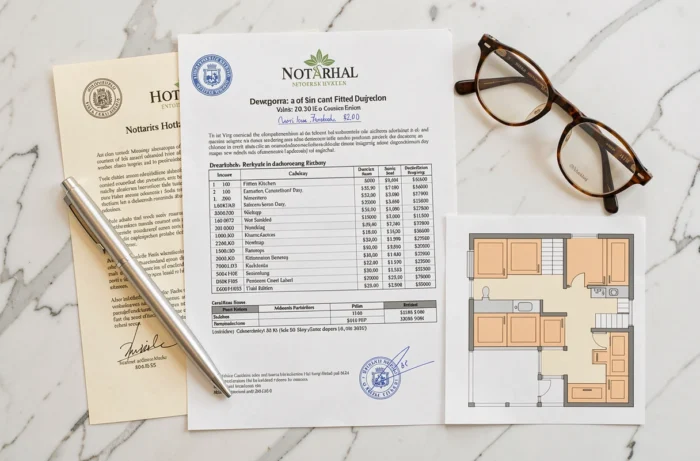
Inventory of deductible furniture: beyond the kitchen
We often focus on the fitted kitchen, but other elements of the property fall under the same logic of deducting notary fees.
- Non-built-in appliances in the kitchen (washing machine, dryer placed in a pantry)
- Removable bathroom furniture, non-sealed mirrors, freestanding storage columns
- Detachable light fixtures, interior blinds, curtain rods
- Garden furniture or outdoor equipment sold with the property (removable gazebo, fixed barbecue on wheels)
The complete inventory must be included in a single document, signed by both parties. Each listed item reduces the base of transfer duties, provided that the same rigor of valuation is respected as for the kitchen.
Tax impact beyond the purchase: resale and furnished rental
The deduction of furniture during acquisition has repercussions that go beyond the simple day of signing. In the event of resale, the acquisition price retained for calculating the capital gain corresponds to the property price excluding furniture. In practical terms, a lower property purchase price can increase the taxable capital gain upon resale.
For investors in furnished rentals (LMNP), the distinction between furniture and real estate also comes into play in calculating deductible expenses. The furniture identified at purchase can be depreciated separately, generating a tax advantage spread over several years.
Before maximizing the deduction of furniture at purchase, it is beneficial to simulate the overall impact on holding and resale taxation. A good decision takes both horizons into account, not just the immediate savings on notary fees.