
A poorly anchored swing set can tip over due to the combined effects of oscillations and wind, sometimes after just a few weeks of use. Securing a swing to the ground is not just a matter of choosing between concrete and an anchoring kit: the type of terrain, the nature of the wood, and the depth of embedding condition the long-term stability of the entire structure.
Wood-concrete contact: a sealing error that accelerates rotting
We regularly observe swing sets where the wooden legs have been directly embedded in concrete. This practice remains widespread, but it causes rapid degradation of the wood. The concrete retains moisture by capillarity at the point of contact, which promotes fungal attacks and the accelerated rotting of the leg.
The technical rule is clear: only metal stakes or sealing plates should be embedded in the concrete. The wood must remain above ground level. This is specifically stated in the user manuals for REBO anchors for swings.
On a class 4 autoclaved wood swing set, the treatment protects against diffuse moisture, not against permanent immersion in a concrete mass. We recommend checking, before purchase, that the technical description of the anchoring kit mentions a system of plate or metal sleeve that isolates the wooden leg from the concrete mass.
To delve deeper into this point and compare the available devices, we refer to the anchoring methods for swings on Les Défricheurs, which detail the variants suitable for each terrain configuration.
Anchoring screws and galvanized stakes: selection criteria for loose soil
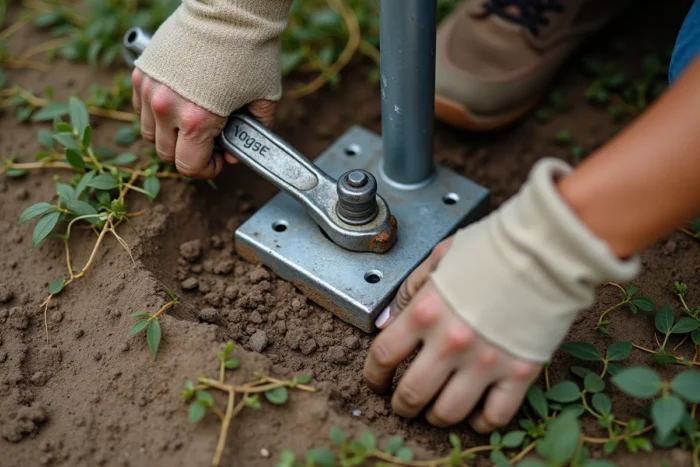
Concrete-free anchoring kits rely on helical screws or straight stakes driven into the ground. Their effectiveness depends on two often-overlooked parameters: the useful length embedded and the corrosion treatment.
Long galvanized stakes, around 40 to 50 cm, offer significantly higher pull-out resistance than the short models sold in entry-level kits. On clay or loamy soil, the depth of embedding radically changes the lateral stability of the swing set, which absorbs the forces generated by swinging.
Hot-dip galvanization protects the steel against underground corrosion for several years. A stake that is simply painted or cold-galvanized degrades within a few seasons when in contact with soil moisture. When purchasing, we recommend checking these points before comparing prices:
- Total length of the stake and length actually embedded (some kits include the above-ground portion in the stated measurement)
- Type of corrosion treatment: hot-dip galvanization, electrolytic zinc coating, or simple painting
- Compatibility with the section of the swing set legs (round diameter or square section)
- Presence of a tightening collar or fixing bracket between the stake and the wooden leg
On sandy or very draining soil, helical screws hold less well than long straight stakes, as the sand does not provide sufficient lateral resistance to the spiral. In this case, concrete sealing with a metal sleeve remains the most reliable solution.
Sizing of concrete sealing holes for wooden swing sets
When concrete is necessary (unstable soil, heavy swing set with slide or climbing wall), the sizing of the sealing hole determines the overall strength. A hole that is too narrow limits the volume of concrete around the metal anchor and reduces the friction surface with the surrounding terrain.
Each hole must exceed the section of the metal sleeve so that the concrete forms a mass capable of resisting tipping forces. The depth must reach the stable soil zone, below the layer of loose topsoil.
The drying time is another critical variable. We recommend not stressing the structure until the concrete has reached its nominal strength, which takes significantly longer than just surface hardening. A swing set loaded too early can create micro-cracks in the mass, which are invisible but detrimental to long-term stability.
Reinforcement of the mass: necessary or superfluous
For a standard domestic swing set, reinforcing the concrete footings does not provide significant benefits. The mass works in compression and lateral friction with the ground, not in bending. Properly mixed and vibrated concrete (or at least poked with a rod to eliminate air bubbles) is sufficient.
However, on soil with a high content of expansive clay, the mass may experience seasonal lateral pressures related to shrink-swell cycles. In this specific case, a welded mesh embedded in the concrete limits the risk of cracking the footing.
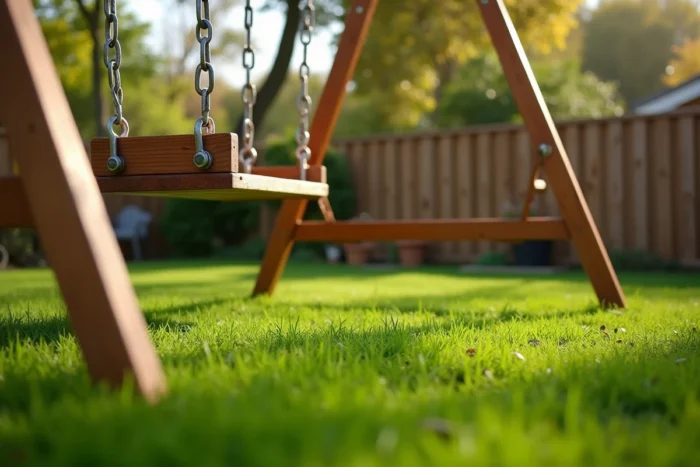
Periodic anchoring inspection: frequency and points to check
An anchoring system should not only be checked at installation. Several manufacturers, including Soulet, emphasize a check at least once per season and after each episode of strong winds. Fasteners gradually loosen without immediate visible signs.
The points to inspect at each check:
- Tightness of the screws and bolts connecting the swing set leg to the metal anchor
- Condition of the galvanization or paint on accessible buried parts (base of the stake at ground level)
- Lateral play of the leg in the sleeve or collar: a noticeable movement by hand indicates loosening or wear
- Settling of the ground around the anchor points, a sign of washout by runoff water
For helical screws, a simple test involves applying vertical pull on the swing set leg. If the screw rises by several millimeters, the ground has become compacted and the anchor needs to be repositioned or replaced with a deeper system.
Replacing an anchoring kit costs little compared to repairing a cracked concrete seal. Anticipating the wear of galvanized stakes, especially on acidic soils, prevents the need to dismantle and reseal the entire swing set after a few years of use.