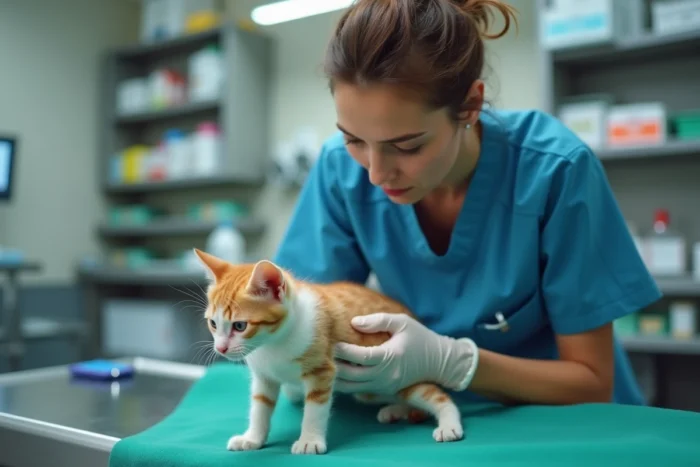
In male cats, the testicles form in the abdomen during embryonic life, near the kidneys. Their migration to the scrotum is a precise physiological process governed by hormonal and mechanical signals. Understanding the steps of this descent allows for early detection of anomalies and intervention before complications arise.
Gubernaculum testis and abdominal migration: the embryonic mechanism
During fetal development, each testicle is connected to the scrotum by a thin fibrous band called gubernaculum testis. This structure acts as a guide: it gradually retracts and pulls the testicle down through the abdomen, then through the inguinal canal.
The migration occurs in two phases. The first, transabdominal, moves the testicle from its renal position to the entrance of the inguinal canal. The second, inguino-scrotal, allows it to traverse this canal to reach the scrotum. Hormonal factors (notably testosterone and anti-Müllerian hormone) orchestrate the retraction of the gubernaculum and the relaxation of surrounding tissues.
A detailed article explains the descent of the kitten’s testicles on AlmAnimal based on these embryonic mechanisms and their practical implications for owners.
If any of these signals are disrupted (genetic anomaly, hormonal defect, anatomical obstruction), the testicle may become stuck along the way. The stopping point varies: deep abdomen, inguinal ring, or subcutaneous area of the groin.

Palpation of the kitten’s testicles: week-by-week timeline
Competitors refer to “the first weeks of life” without precision. Here’s what veterinary practice indicates concretely.
From the first weeks after birth, the testicles can be detected as two small bumps under the skin, just below the anus. At this stage, they are tiny, and palpation requires a gentle touch.
Around eight to twelve weeks, the testicles become significantly more visible and palpable for an attentive owner. Some veterinary sources place clear visibility closer to three months, depending on the kitten’s morphology and the thickness of the subcutaneous tissue.
Current practice recommends waiting at least six months before diagnosing cryptorchidism. Before this age, a late descent remains possible. Some veterinarians even wait until nine or twelve months in borderline cases, as spontaneous migration can still occur after six months.
Cryptorchidism in cats: location of the retained testicle and associated risks
When a testicle does not reach the scrotum within the normal timeframe, it is referred to as cryptorchidism (from the Latin “hidden testicle”). The unilateral form, where one testicle is retained, is the most common. The bilateral form, rarer, is often accompanied by sterility.
Three possible locations for the ectopic testicle
- Abdominal: the testicle remains in the abdominal cavity, sometimes close to its embryonic position. Detection by simple palpation is then impossible and requires an ultrasound.
- Inguinal: the testicle is stuck in the inguinal canal or at its exit. The veterinarian can usually feel it by palpating the groin area.
- Subcutaneous (pre-scrotal): the testicle has almost reached the scrotum but remains lodged just above it, under the skin. This is the easiest situation to identify.
A testicle retained in the abdomen is exposed to a higher body temperature than that of the scrotum. This excessive heat disrupts spermatogenesis and, in the long term, increases the risk of testicular tumors. There is also a risk of testicular torsion, causing acute pain that constitutes a surgical emergency.
Differentiating cryptorchidism and monorchidism
Monorchidism refers to the congenital absence of development of one testicle (agenesis). The cat then truly has only one testicle, which differs from cryptorchidism where the testicle exists but is not in its proper place. Confusion between the two terms is common, including in some popular publications.

Castration of the cryptorchid cat: procedure and surgical choices
The reference treatment remains surgical castration. No hormonal treatment has proven reliable effectiveness in cats to induce the descent of an ectopic testicle.
The surgical technique directly depends on the location of the retained testicle:
- Inguinal or subcutaneous position: the procedure resembles a classic castration, with an incision at the groin. It is quick, and recovery is comparable to standard sterilization.
- Abdominal position: the surgeon must open the abdominal cavity (laparotomy) or resort to laparoscopy to locate and remove the testicle. The procedure is longer, and postoperative follow-up is slightly more demanding.
- Bilateral abdominal cryptorchidism: both testicles are removed via the abdominal route. The cat will be permanently sterile and will no longer exhibit testosterone-related behaviors.
A preoperative ultrasound examination helps the veterinarian precisely locate the testicle and plan the surgical approach. This step reduces the intervention time and the risk of complications.
Should a cryptorchid cat be bred?
The answer is categorical: no. Cryptorchidism has a documented hereditary component. Breeding an affected cat risks passing the anomaly to its offspring. Castration protects both the cat and the lineage.
Veterinary follow-up for the male kitten: essential checks
During the first vaccination visit (usually around eight weeks), the veterinarian systematically palpates the scrotal area. If the testicles are not yet perceptible, a second check is scheduled around four to five months.
At six months, if one or two testicles remain undetectable by palpation, the practitioner generally prescribes an abdominal ultrasound. The diagnosis is then made, and castration is planned, ideally before puberty to limit tumor risks and urinary marking behaviors.
The descent of the testicles in the kitten follows a precise but variable biological timeline from one individual to another. Monitoring this migration during vaccination visits remains the most reliable way to identify cryptorchidism before it becomes problematic.