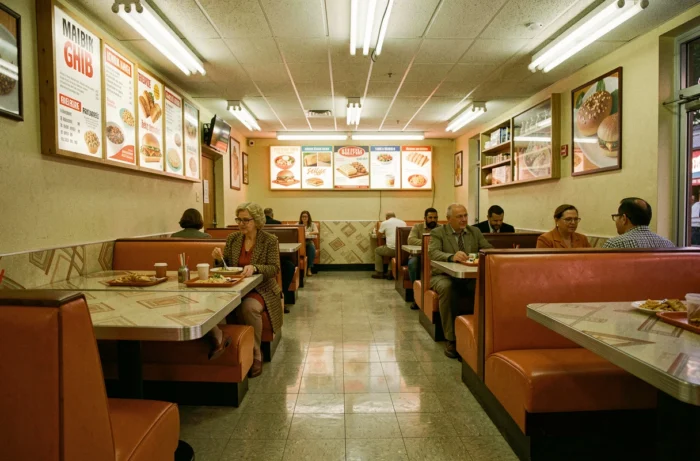
Quick absorbed by Burger King, Flunch in partial liquidation, Courtepaille under judicial control: the brands that have shaped French family outings for three decades are not all disappearing in the same way. Some are swallowed by a competitor, while others close site by site in a slow erosion. Comparing these trajectories helps to understand what truly undermines the restaurant chain model in France.
Comparative table of disappeared or declining restaurant chains
Before analyzing the mechanisms of disappearance, a synthetic overview helps to gauge the extent of the phenomenon. The brands listed here all had significant national presence before losing almost all of their outlets.
| Brand | Period of strong presence | Type of disappearance | Recent situation |
|---|---|---|---|
| Quick | 1980s-2010 | Absorption (Burger King) | Brand almost absent from the territory |
| Flunch | 1970s-2010 | Successive liquidations | Closures still ongoing (Toulouse, Nantes, Saint-Brieuc) |
| Courtepaille | 1960s-2010 | Judicial recovery | Baudaire group placed in recovery mid-2024, more than 90 Courtepaille restaurants affected |
| Nabab Kebab | 2000s-2010 | Collapse of the franchise network | Almost all outlets closed |
| Wimpy | 1970s-1980s | Voluntary withdrawal from the French market | No restaurants in France |
This overview reveals that disappearance does not follow a single pattern. Three mechanisms stand out: absorption by a competitor, gradual judicial liquidation, and the silent collapse of the franchise network.
Several generations of French people have a clear memory of these brands, and many recall the former disappeared restaurant chains with an affection that goes beyond mere culinary matters.
Absorption, liquidation, or abandonment: three distinct mechanisms of disappearance
Quick and the model of commercial absorption
The acquisition of Quick by the Burger King France group illustrates a mechanism specific to fast food: a local brand disappears in favor of a global chain. The premises, equipment, and sometimes staff are retained, but the visual identity, menu, and marketing positioning change entirely.
This type of disappearance leaves few physical traces. Former Quick restaurants become Burger Kings in just a few weeks of renovations. The regular customer loses their landmark without any official closure being announced.
Flunch and step-by-step liquidation
The Flunch case is different. The cafeteria chain was not acquired by a direct competitor. It has been undergoing a series of closures site by site for several years, dictated by commercial courts. The cafeteria in Toulouse closed after 32 years of operation, leading to the layoff of about twenty employees. Several establishments in the West were placed in judicial liquidation on July 3, 2024 (Nantes, Saint-Brieuc).
In Angers, the situation remains unclear: a prolonged closure officially attributed to “technical problems” raises doubts about a reopening. This mode of disappearance is the slowest and most painful for employees, as each site is subject to an individual procedure.
Nabab Kebab and the collapse of the franchise network
Nabab Kebab represents a third scenario, less publicized. The chain, highly visible in shopping centers from 2000 to 2010, saw its network of franchisees disintegrate without any spectacular judicial process. The outlets simply ceased to exist, one after the other, without a restructuring plan or identified buyer.
Pressure on commercial rents and indexing: an underestimated factor
Analyses of the disappearance of chains often focus on changes in consumer tastes or competition from delivery services. One structural factor goes more unnoticed: the indexing of commercial rents to the ILC (commercial rent index).
For a chain operating several dozen leased sites, each point increase in the ILC simultaneously impacts the entire portfolio. When revenue stagnates or declines, the rental burden becomes the primary factor that destabilizes operations.
- Classic commercial leases provide for a triennial revision indexed to the ILC, making the burden predictable but inelastic in the short term.
- Chains located in suburban commercial areas also face rising co-ownership charges related to aging shopping centers.
- The Baudaire group, which operates nearly 180 restaurants including Courtepaille and about fifty La Boucherie, was placed in judicial recovery at the end of June 2024 by the Angers commercial court, a signal that directly concerns the viability of the multi-site model.
In contrast, the brands that have survived (McDonald’s, some premium burger franchises) have often opted for acquiring their premises or for aggressive lease renegotiations, giving them a flexibility that historical French chains lacked.
Repurposing of premises: what replaces the former brands
The premises freed up by the disappeared chains do not always remain empty. In Brittany, an operator of McDonald’s franchises bought an old Rennes shop to transform it into a meat restaurant, according to Ouest-France. This type of repurposing illustrates a broader trend: successful fast-food operators are reclaiming the locations of failing brands.
The phenomenon creates market concentration. Commercial locations pass from one chain to another, but the number of independent operators or original concepts that settle there remains low. Chain restaurants in France are not disappearing; they are recomposing around fewer, more capitalized players.
The closures of Flunch, Courtepaille, or Nabab Kebab do not only tell the story of the end of familiar brands. They reveal a market where the operating cost of a multi-site network exceeds what typical restaurant margins can absorb. Nostalgia is real, but the economic model that supported these chains is no longer viable.