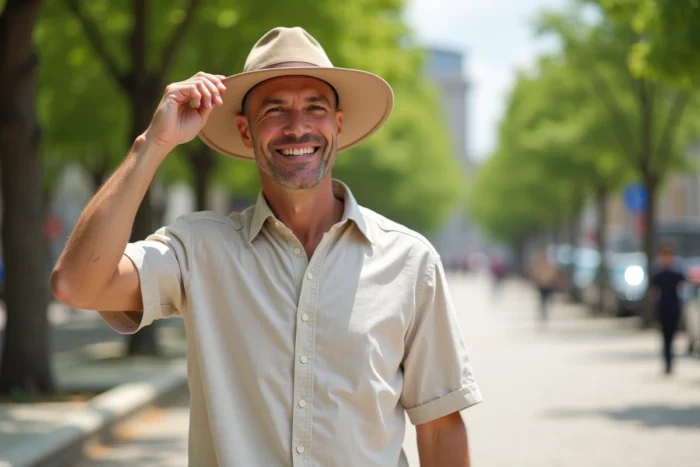
An exposed scalp reflects light and gives a false impression of protection. The skin remains directly exposed to UV rays, without the natural barrier provided by hair. Choosing a cap when bald is as much about dermatological prevention as it is about thermal comfort, and the selection criteria differ significantly from those of a person with hair.
UPF rating and tight weave: the textile specifications that really matter
The UPF (Ultraviolet Protection Factor) measures the fraction of UV rays that a textile allows to pass through. A cap with a UPF 50+ blocks more than 98% of UV rays, making it the benchmark for a hairless scalp. Below UPF 30, the protection is insufficient for prolonged exposure.
The weave is more important than the color. A tightly woven fabric, even if light-colored, filters more than a dark fabric with a loose weave. We recommend checking the density of the textile by holding it up to a light source: if light passes through clearly, the weave does not provide enough protection.
Synthetic fibers (polyester, nylon) treated with anti-UV properties retain their UPF rating longer than cotton, which loses protection over time with washes. Untreated cotton often offers a UPF below 15. Dense recycled polyester, on the other hand, maintains its filtering properties even after several seasons of use.
Choosing a cap suitable for bald men involves balancing these textile parameters with shape and ventilation, two criteria we detail below.
Coverage area and vulnerable zones of the bald scalp
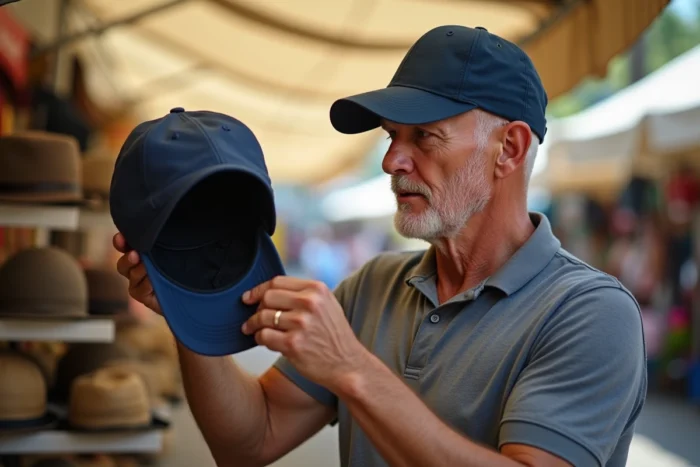
A classic baseball cap protects the forehead and the visor shades the face. The top of the head receives partial coverage, and the nape remains completely exposed. For a bald man, this pattern poses a direct problem: the vertex and the nape are the areas most affected by skin cancers of the scalp.
Long visor, nape protector, and closed panels
The length of the visor determines the shade cast on the nose and ears. A well-sized visor also protects the tops of the cheekbones, where reflection easily reaches the skin.
The removable nape protector, made of UPF fabric, transforms a standard cap into a headwear with nearly complete coverage. Legionnaire-style models come with this flap as standard. Their look is divisive, but their effectiveness on the nape is unmatched among caps.
- Front and side panels made of solid fabric (no mesh) to cover the temples, a thin and highly vascularized area
- Visor wide enough to shade the nose and ears without obstructing the field of vision
- Integrated nape protector or removable clip, to be prioritized as soon as exposure exceeds one hour outdoors
Caps with mesh back panels (trucker) allow UV rays to pass directly onto the occiput. On a hairy scalp, the hair absorbs some of these rays. Without this barrier, the mesh back cancels out protection over the entire area it covers.
Ventilation without compromising sun protection
The heat accumulated under a closed-panel cap drives many bald men towards airy models, at the expense of UV filtration. This compromise is not inevitable if the right ventilation systems are selected.
Side eyelets punched in a dense UPF fabric allow air circulation without creating openings for UV rays. Their reduced diameter limits the amount of radiation that passes through. The absorbent inner bands (sweatband) made of technical fabric wick away sweat and reduce the greenhouse effect under the cap.
Matte material against scalp shine
Dermatologists report that the shine of a bald scalp creates a false impression of protection while the skin remains vulnerable. An inner lining made of matte, absorbent fabric limits this reflection, reduces the feeling of heat, and improves the adherence of sunscreen applied underneath.
We observe that caps lined with matte microfiber stay better in place on a smooth scalp than those with a shiny polyester interior. The stability of the cap prevents constant repositioning, which exposes the scalp with each adjustment.
Sunscreen under the cap: an underestimated double protection
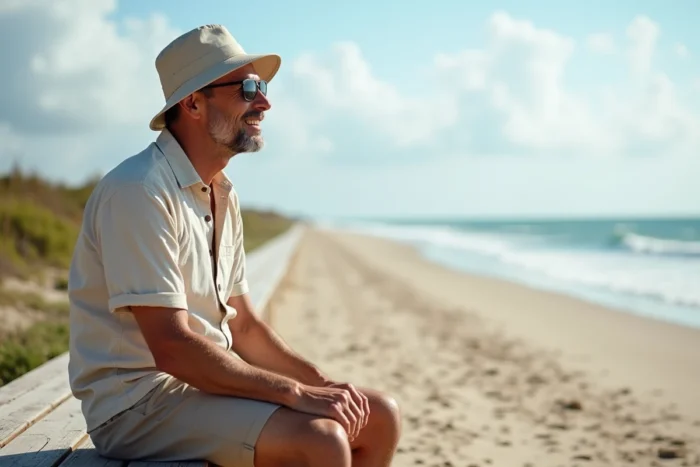
Wearing a cap does not exempt one from applying sunscreen on the scalp. French prevention campaigns emphasize a hierarchical order: shade first, clothing and hat next, sunscreen as a complement and not a replacement.
The scalp sweats, the cap moves, and UV rays partially penetrate uncertified textiles. A layer of broad-spectrum sunscreen under the cap compensates for these shortcomings. Fluid or spray textures spread more easily on a hairless scalp than a thick cream.
- Apply sunscreen at least ten minutes before putting on the cap to allow the film to stabilize
- Reapply if the cap is removed, even briefly, during exposure
- Prefer a photostable broad-spectrum filter, covering UVA and UVB, for prolonged effectiveness under the textile
The FDA has recently approved bémotrizinol (Tinosorb S) as a recognized safe and effective UV filter, paving the way for more stable and better-tolerated sunscreens for daily application on the scalp.
Combining a UPF 50+ textile with suitable sunscreen and regularly monitoring the condition of the scalp with a dermatologist constitutes the strongest strategy. A well-chosen cap does most of the work, but it does not replace either the chemical filter or medical follow-up.