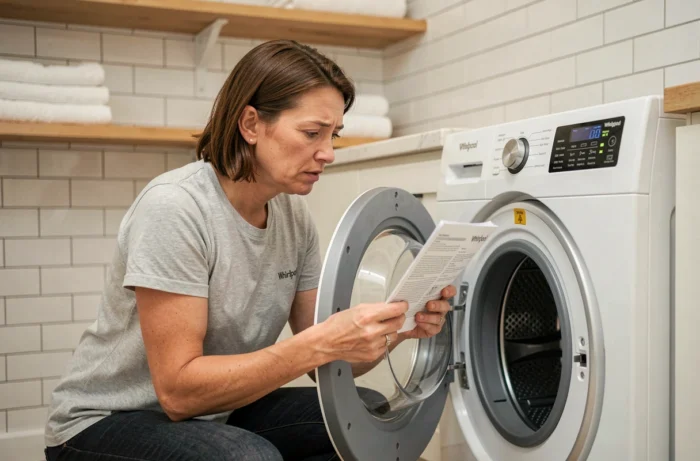
The 6th Sense technology embedded in Whirlpool 9 kg washing machines (models FFBP, FFSPL, FFWDB) relies on a network of sensors that adjust the load, water level, and temperature in real time. The manual provided with these models is lacking in several critical areas, particularly regarding the logic of anomaly detection and the actual behavior of the Eco 40-60 program. Here, we detail the technical gray areas and the most common diagnostic errors.
Whirlpool washing machine Eco 40-60 program: what the manual does not specify about consumption
The manual mentions the Eco 40-60 program without explaining why it lasts significantly longer than daily cycles. The reason is regulatory. Since March 1, 2021, the new European energy label (recalibrated scale A to G) bases the energy class of the washing machine exclusively on the consumption of the Eco 40-60 program for 100 cycles.
An older Whirlpool 6th Sense model previously rated A+++ may now appear in class B or C, without any change in its actual consumption. The extended duration of the Eco cycle compensates for the reduced heating temperature: the heating element works less, thus consuming less, but the mechanical agitation is prolonged.
We regularly observe users selecting a quick cycle because they find the Eco too long, without understanding that their energy label no longer corresponds to the actual consumption. This is a point that the Whirlpool 6th Sense washing machine manual would benefit from clarifying, as the paper manual simply lists the programs without detailing this logic.
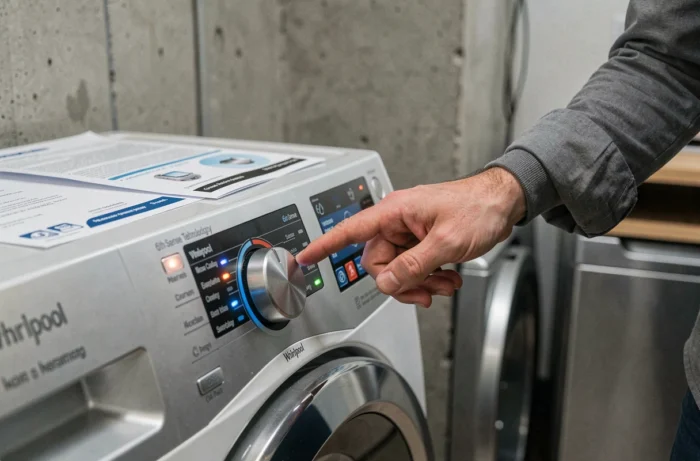
Whirlpool 6th Sense electronic board: service bulletin and recurring failures
In March 2024, Whirlpool issued an internal service bulletin covering most of its top-loading washing machines manufactured between January 2023 and May 2024. The identified defect concerns the control board, which may cause unexpected cycle stops, random error codes, and a complete machine lockup.
The manufacturer’s recommendation is the preventive replacement of the board for certain serial numbers. The user manual makes no reference to this type of recall. We recommend systematically checking the serial number (visible on the nameplate, inside the door frame) before any intervention on a persistent error code.
Symptoms not to be confused with a component failure
An intermittent F01 or F03 code after a brief power outage rarely points to a water supply or drain pump issue. The defective electronic board generates erroneous codes that lead to false leads. If the same code appears on two different cycles without hydraulic logic (the tap is open, the filter is clean), the board is the primary suspect.
Whirlpool 6th Sense error codes: diagnostic hierarchy
The manual classifies error codes in alphabetical or numerical order. In intervention, this presentation is of no use. We apply a diagnostic hierarchy based on the probability of cause:
- F06 (motor/tachometer): often a false alert on the 6th Sense 9 kg. Unplug the machine for ten minutes, restart a short cycle. If the code returns, check the motor connector before replacing anything.
- F03/FP (drainage): clean the pump filter, check the drainage hose, then only test the pump with a multimeter. A bent hose at the machine’s outlet causes this code in most cases.
- F04 (heating): the NTC sensor drifts before the heating element fails. Measure the sensor’s resistance at room temperature before ordering a new heating element.
- F01/FH (water supply): check the flow at the tap, then the solenoid valve. On 6th Sense models, the pressure sensor may signal a water fault when the problem comes from a clogged pressure switch.
- F02/FA (Aquastop): check for water presence in the retention tray under the machine. A simple cleaning of the float often suffices to eliminate the code.

Resetting the board: the sequence omitted by the manual
The manual does not detail the electronic reset procedure. Unplug the power cord and wait at least five minutes (ten minutes for connected 6th Sense Live models). Plug back in, then hold the Start/Pause button for three seconds before selecting a program.
This action clears temporary codes related to a power surge. If the code persists after two resets, the fault is hardware.
QR code on the Whirlpool energy label: access to the EPREL product sheet
Since 2021, European regulations require a QR code on the energy label of each washing machine. This QR code links to the official EPREL database (European Product Registry for Energy Labelling), which contains the complete technical sheet of the model: consumption per cycle, noise level during spinning, spin efficiency class, weighted water consumption.
This sheet is more precise than the paper manual for comparing actual performance between programs. Few users scan this code, even though it provides access to standardized data that the manual does not reproduce.
When scanning this code is truly useful
Before contacting customer service for supposed overconsumption, compare the duration and water consumption of the cycle used with the EPREL values of the Eco 40-60 program. A significant discrepancy between the selected cycle and the reference data does not indicate a malfunction, but rather an inappropriate program choice according to standardized measurement.
The diagnosis of a Whirlpool 6th Sense washing machine relies less on the sequential reading of the manual than on understanding the embedded sensor logic. Checking the serial number against the 2024 service bulletin, scanning the QR code on the energy label, and applying the probability hierarchy on error codes avoids the majority of unnecessary interventions.