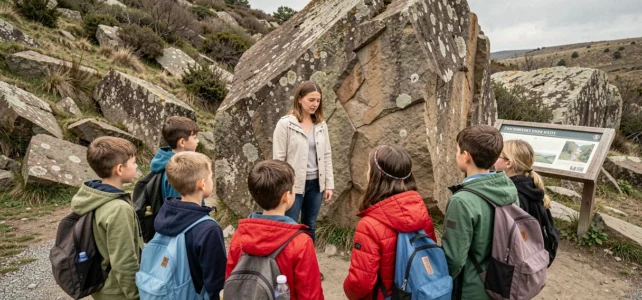
A teacher who takes their class to a wastewater treatment plant for a lesson on the water cycle receives spontaneous questions that three classroom sessions would not have provoked. This gap between the theory projected on the board and the reality perceived on site is the main driving force behind school outings.
Since a circular issued in June 2023 (reference MENE2310475C), the Ministry of National Education reminds that every student must benefit from at least one school trip during their compulsory education, turning these experiences into a quasi-educational right.
Regulatory framework for school outings in 2024: what has changed
The circular of July 16, 2024 (MENE2407159C) clarified a point that was causing recurring administrative blockages. Mandatory outings included in the timetable are free and cannot require a specific school insurance. Families therefore do not have to provide any additional documentation for these regular or occasional outings.
The distinction becomes clear for optional outings and trips with overnight stays, which do require specific coverage. This clarification has a concrete effect: it removes a financial and administrative barrier that was preventing some teachers from planning nearby outings, those that cost nothing but require authorization.
To organize school outings with Réseau Éducation, there is a structured framework that facilitates the implementation of these projects while respecting educational requirements.
Memory anchoring and multisensory learning outside the classroom
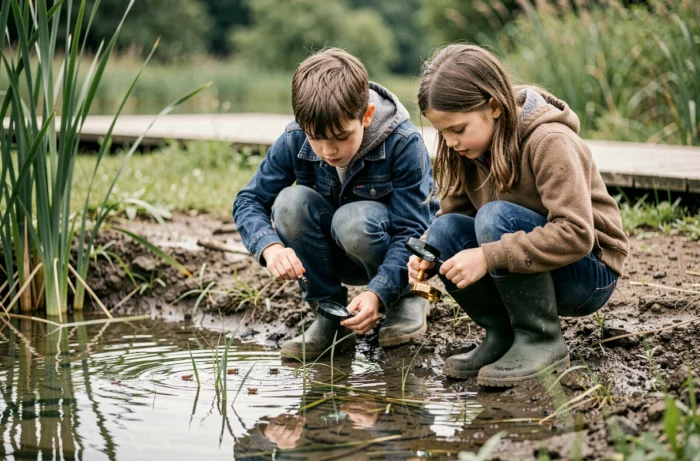
We often talk about concrete learning, but the precise mechanism deserves attention. In the field, the child simultaneously engages multiple sensory channels: they see, touch, smell, and hear. This multisensory stimulation promotes more durable memory encoding than a lesson read or passively listened to.
A telling example: during a visit to the forest for a science lesson, students identify tree species by handling leaves and bark. Botanical vocabulary becomes anchored because it is associated with a texture, a smell, a spatial context. This is not an abstract pedagogical hypothesis; it is an observation shared by teachers who regularly conduct field trips.
Preparing the ground before the outing
The pedagogical effectiveness of an outing largely depends on prior preparation. Without preparation, the visit becomes a pleasant stroll but not very exploitable. It is beneficial to work in class on the concepts that the outing will illustrate, and then to formulate questions with the students that they will seek answers to on site.
A field notebook with three to five targeted questions is enough to transform passive observation into an active approach. Feedback on this point varies according to the students’ age, but the principle remains the same from elementary to middle school: give a precise observation mission.
School outings and transversal skills: what the classroom does not replicate
The most underestimated benefit of outings does not concern disciplinary knowledge. It relates to the skills that the curricula refer to as “transversal” and that the field naturally reveals.
- Peer cooperation takes a different form when it is necessary to navigate together on a path or conduct an investigation in a museum. The usual social roles in the classroom are redistributed.
- Autonomy is developed through managing materials, adhering to a schedule, and spontaneous note-taking, all micro-responsibilities absent from the traditional school framework.
- Oral communication develops during exchanges with external speakers (guide, artisan, scientist), who do not speak like a teacher and require an adaptation of the language register.
These skills do not appear on a numerical evaluation, but they directly contribute to the formation of students capable of acting in varied contexts.
Pedagogical exploitation after the outing: the often neglected time
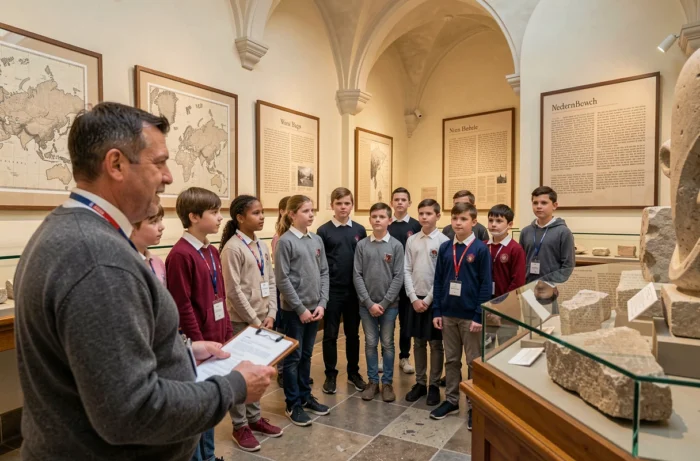
Time is invested in logistical organization and prior preparation, but the return to class after the outing remains the weak link in many projects. Without structured exploitation, learning evaporates in a few days.
Concrete methods of restitution
Rather than a traditional written report (often tedious for both students and teachers), we can vary the formats of restitution:
- A wall of commented images, where each group associates a photo taken on site with a concept from the curriculum, works well from third grade to middle school.
- A structured debate based on the contradictory observations of students allows for working on argumentation while consolidating content.
- A collective mind map, built progressively, makes visible the link between what was seen in the field and the theoretical course.
The goal is not to produce a “beautiful” document but to force the articulation of what has been experienced, because it is this verbalization that transforms the experience into lasting learning.
Integrating the outing into a long sequence
The outing gains impact when it is part of a pedagogical sequence lasting several weeks. It can be used as a trigger (at the beginning of the sequence to generate questions) or as validation (at the end of the sequence to verify understanding in a real context). An outing isolated from the rest of the program loses half of its potential.
Teachers who schedule two or three outings a year on the same theme (a neighborhood, a local ecosystem, a regional heritage) notice a clearer progression in student engagement, as each outing feeds into the next.
The 2023 circular that establishes the right to at least one school trip during compulsory education sets a baseline. In the field, educational teams that exceed this minimum and integrate outings as a regular teaching tool achieve results that the walls of the classroom, no matter how well-equipped, do not replicate.