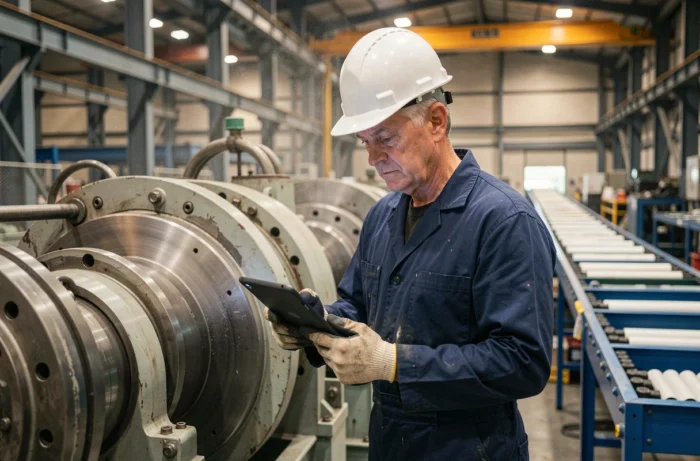
Optimizing industrial maintenance without interrupting production requires solving a multi-variable equation: data reliability, technician skills, regulatory constraints, and cybersecurity of operational networks. In 2026, the challenge is no longer choosing between preventive and predictive maintenance, but rather the ability to connect sensor signals to the rest of the decision-making chain (available parts, work authorizations, production scheduling).
Quality of maintenance data: the barrier that IoT sensors alone cannot solve
Discussions about predictive maintenance highlight IoT sensors and artificial intelligence as directly actionable levers. The operational reality is different. The quality of data remains the main barrier to the industrialization of predictive maintenance.
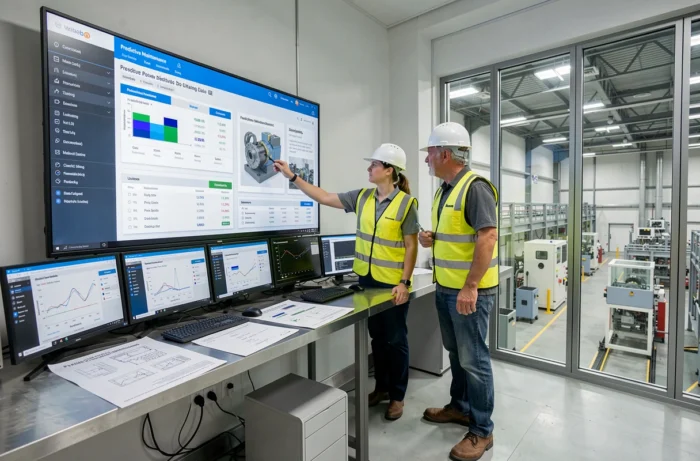
A vibration sensor installed on a production machine generates a continuous stream of measurements. This stream only becomes usable if three conditions are met: a structured and reliable maintenance history, an up-to-date spare parts reference, and a correspondence between alert thresholds and the actual failure modes of the equipment.
When one of these layers is missing, the captured signal does not trigger the right intervention at the right time. The technician receives an alert, but without sufficient context to decide whether to intervene immediately or postpone to the next available slot on the line. This gap between detection and action is what today distinguishes a site that is experimenting with predictive maintenance from one that has truly industrialized it.
The challenge for maintenance managers in 2026 is more about data governance than purchasing additional sensors. Documenting each intervention, standardizing failure codes, cleaning existing databases: these tasks, often perceived as administrative work, condition the relevance of any downstream predictive algorithm. To delve deeper into this topic, Airbuzz’s industrial expertise details the skills necessary for field teams to support this transition.
OT cybersecurity and the NIS2 directive: a blind spot in uninterrupted maintenance strategies
Keeping a machine running during an intervention often involves remote access, whether for telemaintenance by the manufacturer or for controlling parameters via a SCADA system. The NIS2 directive turns telemaintenance into a regulatory compliance issue, not just operational efficiency.
NIS2 mandates risk management, securing the supply chain, access control, and incident notification. In France, the scope of application still depends on transposition and its regulatory texts. Affected industrial companies must map remote access from machine manufacturers, segment IT and OT networks, and prepare notification procedures in case of an incident.
| NIS2 Requirement | Impact on industrial maintenance |
|---|---|
| Risk management | Mandatory risk analysis before any remote access to production equipment |
| Securing the supply chain | Audit of telemaintenance access granted to manufacturers and subcontractors |
| Access control | IT/OT network segmentation, enhanced authentication for remote interventions |
| Incident notification | Documented procedure to report any compromise affecting a production system |
Most guides on uninterrupted production maintenance do not link these obligations to the reality on the ground. A technician connecting to a controller from a non-segmented workstation potentially exposes the entire production line. Segmenting OT networks is no longer optional; it is a prerequisite for any connected maintenance strategy.
Predictive maintenance and machine regulation: the risk associated with decision-making AI
Future European rules on machines introduce a specific risk for maintenance based on artificial intelligence. When an algorithm recommends delaying an intervention or modifying an operating parameter, the question of liability arises.
An algorithm that delays an intervention engages the responsibility of the operator, not that of the software solution provider. This distinction, still unclear in many companies, will become a compliance issue as the texts become clearer.
Maintenance teams must therefore have complete traceability of decisions made by automated systems:
- Timestamp of each recommendation issued by the algorithm, with the associated confidence level and the input data used
- Documented human validation before any deferred action on equipment classified as critical for safety
- Archiving discrepancies between the algorithmic recommendation and the technician’s final decision, to feed back into experience
This traceability framework is not just a legal precaution. It directly feeds the improvement loop of predictive models by identifying cases where the algorithm was wrong and the reasons for human correction.
Isolated sites and uninterrupted maintenance: the limits of standardized approaches
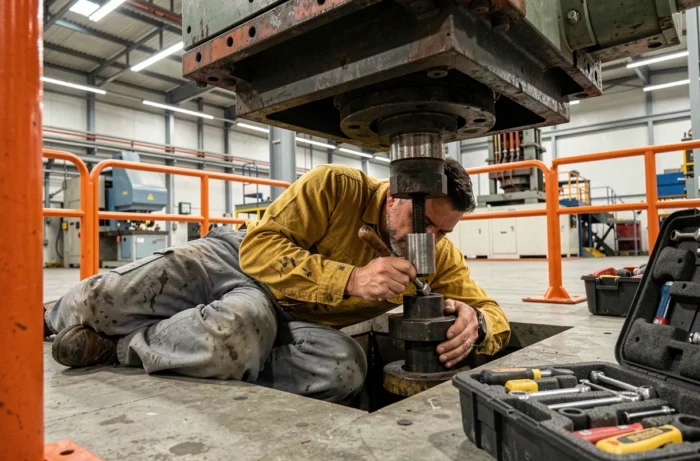
General guides on predictive maintenance presuppose stable network connectivity and quick access to spare parts. Isolated sites (mines, offshore platforms, factories in rural areas) invalidate these assumptions.
On these sites, network latency prevents real-time data from being sent to a cloud platform. The lead time for spare parts can be counted in days, sometimes weeks. An uninterrupted maintenance strategy must then integrate:
- Local storage of sensor data with deferred synchronization, to maintain analytical capability even without a permanent connection
- Predefined degraded modes allowing the technician to make autonomous decisions based on simplified thresholds
- A stock of critical parts sized based on failure history, not on a generic supplier catalog
- Enhanced training for local teams, capable of interpreting signals without remote assistance
Upskilling maintenance technicians on these sites is often an underestimated lever. A technician trained in interpreting field data partially compensates for the lack of connectivity and reduces dependence on remote experts.
The availability rate of a production line depends less on the technological sophistication deployed than on the coherence between data quality, human skills, and compliance with the regulatory framework. The companies that are truly making progress in 2026 are those that address these three dimensions simultaneously, without waiting for one to be perfect before advancing on the others.