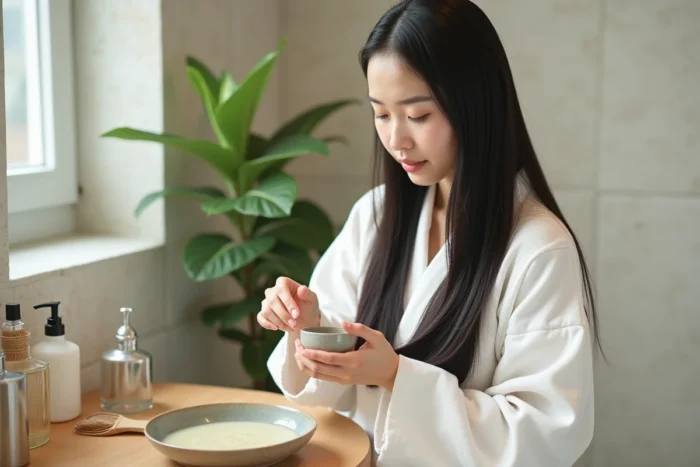
The softness of Korean hair is based on a hair care approach that treats the scalp as an extension of the facial skin. This logic, rooted in K-beauty culture, prioritizes the health of the scalp over the appearance of the hair fiber. Understanding this hierarchy helps explain why results differ so much from Western routines focused on shampooing and conditioning.
Scalp treated like facial skin: the founding principle
In Korea, the scalp is not seen as just a support for hair. It receives the same categories of care as facial skin: exfoliation, hydration, protection. This approach stems from a simple physiological observation: a hair follicle clogged with sebum or pollution residues produces a weaker and duller hair.
Regular exfoliation of the scalp, often using gentle acids (salicylic acid, PHA), removes dead cells without damaging the skin barrier. This step, performed once or twice a week, precedes shampooing and prepares the scalp to better absorb the active ingredients of subsequent treatments.
Finding Korean hair care on Owly Mary helps to better understand this philosophy where each step targets the root before the length.
Hair serums and essences: active ingredients borrowed from skincare
One of the most distinctive contributions of the Korean hair care routine is the use of serums and essences applied directly to the scalp. These lightweight formulations, inspired by facial serums, contain concentrated active ingredients: niacinamide, peptides, fermented rice extracts.
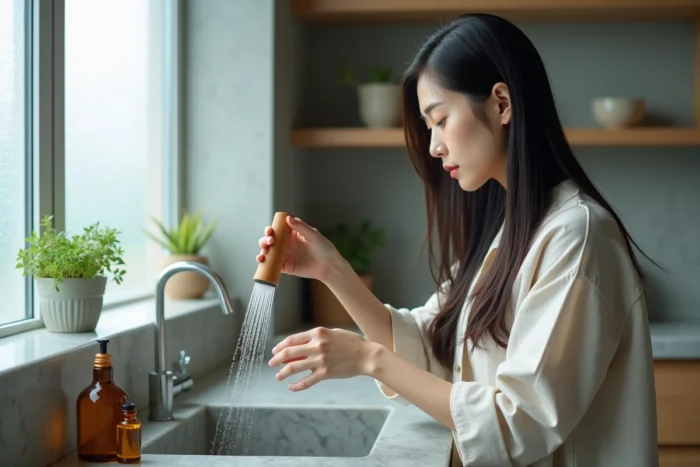
The goal is not to coat the fiber (as a classic mask would), but to nourish the hair bulb. The difference is seen in the long term: a well-hydrated and protected bulb produces hair that is naturally more flexible and more resistant to breakage.
Korean hair essences also stand out for their watery texture. They do not leave a greasy film, making them compatible with fine hair, which is often overlooked by richer Western nourishing products containing more silicones or heavy oils.
Korean Head Spa: the sensory dimension of hair care
The Head Spa represents the most visible evolution of Korean hair care in recent years. This ritual, practiced in specialized salons, combines scalp massage, application of targeted masks, and sometimes the use of steam or LED devices.
The sensory dimension is not incidental. Prolonged scalp massage stimulates blood microcirculation, which promotes nutrient supply to the follicles. The masks applied during the Head Spa often contain fermented actives (sake yeast, fermented soybean extract) whose bioavailability is higher than that of non-fermented versions.
What differentiates the Korean Head Spa from a simple salon treatment in the West is the duration and sequence: the protocol generally lasts longer and follows a precise order, from detoxifying the scalp to nourishing the lengths, including a phase of active relaxation.
What results to expect from regular Head Spa sessions
A one-time Head Spa mainly provides an immediate shine effect, linked to the mechanical smoothing of the cuticle through massage. The effects on hair softness and strength appear with regularity: Korean enthusiasts practice this ritual once or twice a month.
Hair clinics and at-home devices: trichology enters the routine
The most recent trend blurs the line between cosmetics and medicine. Since 2025, Korean hair clinics have been developing anti-hair loss and care devices designed for home use. The brand Solep, a subsidiary of Wellkin (a Korean chain of hair clinics), for example, presented an innovative anti-hair loss system aimed at the general public at Cosmobeauty Seoul 2026.
This hybridization between clinical trichology and daily routine changes the very definition of Korean hair care. The softness of hair is no longer just the result of a good shampoo followed by a mask: it becomes a medical-cosmetic goal, supported by technologies that act on the density and quality of the fiber right from the follicle.
What Korean trichology brings to classic routines
Devices from the clinical field (hair LEDs, professional peels adapted for home use) do not replace cosmetic treatments. They are added upstream, addressing issues that cosmetics alone cannot resolve:
- Hair loss related to chronic inflammation of the scalp, which gentle shampoos alone cannot reduce
- Progressive thinning of the hair fiber, on which masks have no effect since they do not act on the bulb
- The imbalance of the scalp microbiome, which cosmetic exfoliants partially regulate but clinical treatments target more precisely
Key ingredients in Korean hair cosmetics
Several families of ingredients consistently appear in Korean formulations, and their selection is not trivial:
- Fermented extracts (rice, soybean, yeasts): fermentation increases the concentration of amino acids and B vitamins, two elements that strengthen keratin
- Camellia (tsubaki oil): used for centuries in Japan and Korea, this lightweight oil penetrates the fiber without weighing it down, making it suitable for both fine and thick hair
- Centella asiatica: known in skincare for its soothing properties, it calms irritated scalps and reduces itching post-coloring
- Rice vinegar: used as a final rinse, it tightens the cuticle scales and gives a mirror-like effect to the hair
These ingredients share a common point: they prioritize gradual repair over immediate cosmetic effect. Shine comes from healthy hair, not from a silicone film that masks damage.
The Korean hair care routine does not have a single formula. Its strength lies in this logic of deep care, from the scalp to the tips, with actives whose effectiveness relies on regularity rather than the promise of spectacular results after a single application. Recent advances in clinical trichology only extend this philosophy into a more technical realm, now accessible outside specialized salons.