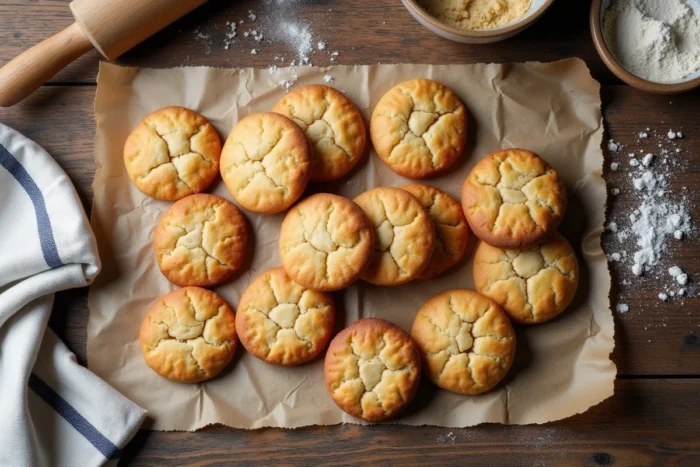
The Breton craquelin is a type of échaudé biscuit, meaning it is poached in hot water before being baked. This double cooking gives it its disc shape with raised edges, its crust that cracks under the bite, and its airy, melting crumb. Its name is thought to come from the Dutch “crakelinc,” literally meaning “that cracks under the bite.”
Échaudage of the Breton craquelin: the technique that changes everything
Most biscuit recipes go straight into the oven. The craquelin, however, first undergoes a dip in boiling water. This step causes the starch grains contained in the gluten of the dough to burst, making the biscuit more digestible and giving it its unique puffed texture.
Specifically, the dough shaped into discs is briefly submerged in a large pot of simmering water. When they rise to the surface, they are ready to be drained and then baked. It is the échaudage that distinguishes the craquelin from a simple brioche roll.
The temperature of the water matters. If it’s too hot, the dough breaks apart on the surface, and the craquelin loses its shape. If it’s not hot enough, the starch doesn’t burst sufficiently, and the result remains dense. Water that is simmering without boiling vigorously gives the best results. The poaching time is brief: as soon as the dough floats, it is removed.
Adapting a homemade Breton craquelin recipe to your kitchen primarily involves mastering this technique. Without proper échaudage, the biscuit does not rise and remains flat.
Ingredients and kneading of the craquelin dough
The basic composition is simple: wheat flour, butter, warm milk, one egg, a pinch of salt, and baker’s yeast. No sugar in the traditional version, or very little. The classic Breton craquelin lies between a dry biscuit and a puffed roll.
- The butter should be soft, gradually incorporated into the flour to obtain a pliable dough without being sticky. Butter that is too cold creates lumps that are impossible to smooth out during kneading.
- The milk is warmed just enough to activate the baker’s yeast. Milk that is too hot kills the yeast, while cold milk slows the rise to the point of being insufficient.
- The egg provides binding and contributes to the browning on the surface after baking. Some traditional versions add an extra yolk to enrich the dough.
The kneading must be vigorous. The recipe published in 1607 in the “Thrésor de santé” already mentions that one “grinds the dough with the broy, which is a large, round, short pestle.” The goal is to develop the gluten network so that the dough withstands the échaudage without disintegrating.
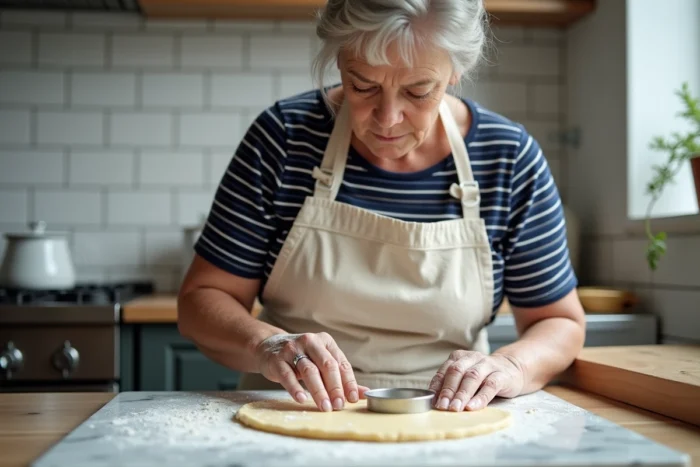
A resting period of about fifteen minutes after kneading allows the dough to relax. It can then be shaped more easily into regular discs.
Baking: temperature and signs of proper cooking
After the échaudage and a brief draining on a clean cloth, the craquelins go into the oven. The baking should be long at a moderate temperature to dry the inside without burning the crust.
The craquelin is ready when its surface is evenly golden and the raised edges are firm to the touch. A craquelin taken out too early remains soft in the center and loses its characteristic crunch as it cools. An overcooked craquelin becomes brittle and bitter.
Placing the pieces on parchment paper prevents them from sticking. Spacing the discs adequately on the baking sheet is necessary, as they will puff up slightly in the oven. Allowing them to cool on a rack lets any residual moisture escape: this is what ensures a dry and crispy craquelin several days after baking.
Variations of the craquelin: savory, sweet, and grain-based
The Breton craquelin lends itself to many variations, which explains its longevity since the Middle Ages.
Stuffed savory craquelin
Its neutral taste makes it a perfect base for savory fillings. Split in half, it can hold smoked salmon, herb cream cheese, fish rillettes, or even a mini-burger assembly. Artisans from Saint-Malo offer combinations with farm dairy products, aged cheese, or raw cream, in a regional pairing logic.
Sweet and chocolate variations
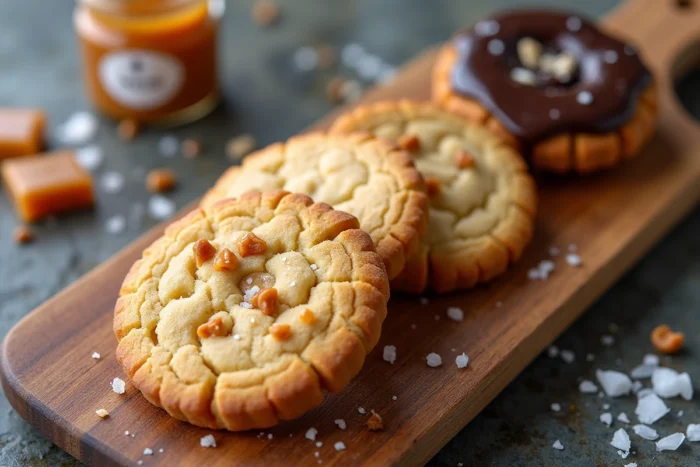
On the sweet side, the craquelin can be spread with salted butter and jam, or dipped in melted chocolate. Some pastry chefs flavor it with praline or lemon. The sweet version requires adding a bit of sugar to the base dough, which slightly alters its behavior during échaudage: the surface caramelizes more in the oven.
Grain and seed versions
In recent years, Breton artisans have been offering craquelins enriched with whole grains or seeds (flax, sesame, sunflower). The technical challenge is to maintain the characteristic puffiness despite the reduced gluten content associated with these alternative flours. The poaching time and the choice of a flour with sufficient strength are then adjusted to compensate.
Storage of homemade Breton craquelin
A well-baked and well-dried craquelin can be stored for several days in an airtight container, away from moisture. It is precisely its double cooking that gives it a longer shelf life than a classic bread. Furetière, in his Universal Dictionary of 1684, already described it as a “very dry pastry.”
Avoid any contact with moist food in the storage container, or risk softening the crust within hours. If the craquelins have lost their crunch, a quick trip in a warm oven will restore their original texture.
Versions enriched with seeds or filled with butter do not keep as long. It is better to consume them within two days or freeze them before échaudage, in the form of raw dough pieces, to bake on demand.