Brittany produces much more than postcards of granite coasts. Behind the landscapes, a craft industry shapes objects and products that bear the mark of a territory, its raw materials, and the know-how passed down through generations. Understanding this production also means grasping what distinguishes a Breton artisanal product from a generic souvenir.
European protection of Breton know-how: what the 2025 regulation changes
Since December 1, 2025, a European regulation allows for the registration of protected geographical indications (PGI) for artisanal and industrial products, not just for food items. Brittany’s granite is among the French know-how mentioned in this context.
This regulatory evolution provides a legal framework for productions that, until now, had no official recognition at the European level. For Breton artisans working with stone, ceramics, or textiles, this means enhanced traceability and protection against imitations.
Field feedback varies on the immediate commercial impact of this measure. Some artisans see it as a medium-term leverage for valorization, while others highlight the administrative burden of registration. What is factual is that Brittany now has a protection tool for its artisanal know-how comparable to what already existed for cider or salted butter.
Industries such as Quimper faience or local weavings could eventually submit similar applications, even though no procedures have been made public at this stage. One can explore part of this Breton artisanal diversity on breizheo.com, which brings together products from these regional sectors.
Breton marine cosmetics: an industry that is professionalizing
Breton beauty is not limited to landscapes. The region hosts a marine cosmetics sector that is currently being structured, driven by the richness of seaweed, seawater, and marine mud along its coasts.
A recent signal illustrates this dynamic: the Aquatonale laboratory, specialized in marine biotechnology, was acquired in January 2026 and renamed Belle en Mer. This consolidation movement shows that the sector is moving beyond the artisanal stage to enter a logic of branding and professional distribution.
Breton thalassotherapy centers (Saint-Malo, Quiberon, Concarneau) now offer tailored protocols with beauticians trained in professional marine cosmetics. We are far from simple tourist treatments: the products used rely on locally extracted active ingredients, with documented manufacturing processes.
For consumers, the distinction between artisanal and industrial marine cosmetics remains blurred. A seaweed soap sold at a Breton market can be handmade in small batches or produced from a semi-industrial line. The lack of a unified label makes it difficult to discern, even though the mention “made in Brittany” provides an initial geographical filter.
Markets and artisan workshops in Brittany: sales venues that structure the offer
Breton craftsmanship does not only thrive in shops or online. A significant portion of sales occurs at seasonal markets and in workshops open to the public, which alters the relationship between artisan and buyer.
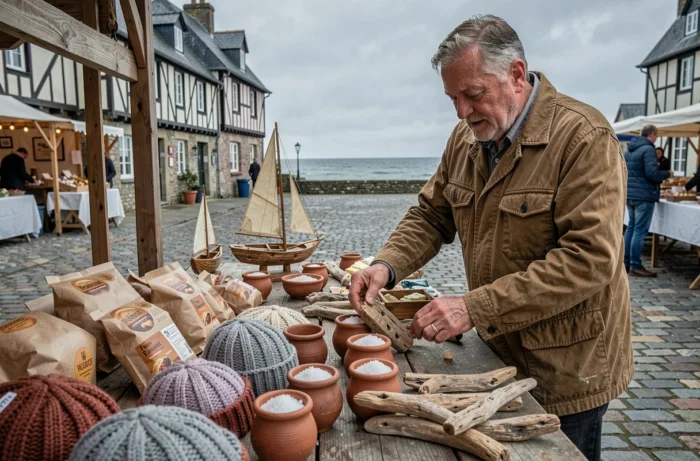
The artisan market in Saint-Goustan, in Auray, gathers local exhibitors every summer. This type of event allows artisans to showcase their work without intermediaries, and visitors to see the manufacturing gestures. The trade fair in Pays Bigouden, in Quimper, combines craftsmanship, commerce, and innovation in a format that goes beyond a simple market stall.
These collective spaces play a role that online platforms do not fulfill in the same way:
- Direct contact with the artisan allows questions about raw materials, techniques, and production conditions.
- The seasonality of markets creates a rarity that pushes some artisans to produce limited series, unavailable the rest of the year.
- Open workshops (ceramists in Concarneau, weavers in Finistère) offer complete transparency about the manufacturing process.
However, access to these circuits remains unequal across territories. The coast concentrates the majority of events, while artisans located inland in Brittany have less visibility.

Breton cultural heritage and the identity of artisanal products
What gives character to Breton artisanal products is not just the raw material. It is the anchoring in a regional culture that informs aesthetic choices, patterns, names, and uses.
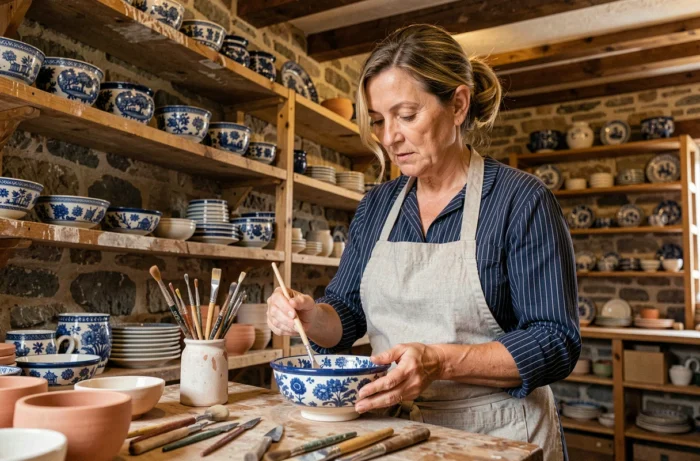
The Breton bowl, for example, far exceeds a utilitarian object. Its system of hand-painted names makes it an identity marker, given for specific occasions. Quimper faience, with its figurative decorations inspired by scenes of Breton life, follows visual codes passed down for several centuries.
This cultural dimension raises a question that the artisans themselves pose: how to renew forms without losing regional identity? Some contemporary ceramists incorporate motifs from Breton history into objects with clean lines. Others embrace a traditional aesthetic without compromise.
Breton concept stores, which are multiplying in cities like Nantes or Rennes, attempt to address this tension by selecting creators who reinterpret heritage. The result is a two-speed Breton craftsmanship: on one side, pieces faithful to historical techniques, on the other, contemporary creations that claim their origin without reproducing it identically.
The beauty of Brittany as it emerges in its artisanal products lies precisely in this coexistence. The offer is neither limited to nostalgia nor to uprooted design. It reflects a region where heritage remains a living material, shaped by artisans whose aesthetic and technical choices continue to evolve.