
The descaling of a rented hot water tank generates recurring disputes between tenants and landlords. The difficulty lies not in the general principle (regular maintenance is the tenant’s responsibility), but in the exact definition of the term “descaling”: a simple draining with rinsing does not require the same skills or budget as an intervention that necessitates the complete removal of the heating element. It is precisely this technical boundary that determines who pays.
Descaling the hot water tank: tenant or landlord responsibility depending on the type of intervention
| Type of intervention | Responsibility | Basis |
|---|---|---|
| Rinsing the tank, periodic draining | Tenant | Regular maintenance (decree no. 87-712) |
| Handling the safety group | Tenant | Regular maintenance |
| Descaling with removal of the heating element | Landlord | Heavy technical intervention |
| Replacement of the anode or heating element | Landlord | Wear part related to aging |
| Complete replacement of the tank (aging) | Landlord | Obligation to provide decent housing |
This table summarizes the dividing line as outlined in decree no. 87-712 of August 26, 1987, and recommendations from manufacturers like Thermor. The “Responsibility” column shifts as soon as the operation exceeds actions that can be performed without specialized tools.
The question of tenant hot water tank descaling becomes even more pressing as the recommended frequency (every two to three years, more often in hard water areas) does not correspond to any legal obligation for an electric water heater.
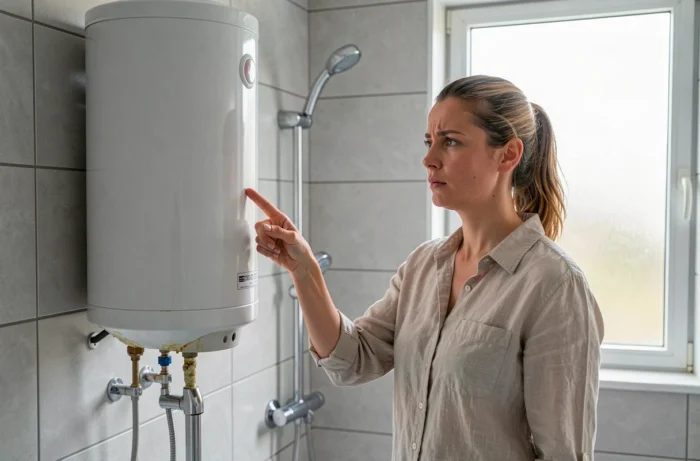
Electric water heaters and gas water heaters: different maintenance obligations
No legal obligation for annual maintenance exists for electric water heaters. This is a major difference from gas appliances, which are subject to mandatory annual maintenance by a qualified professional under the decree of September 15, 2009.
For a gas water heater, the tenant must call a professional each year and keep the maintenance certificate. The cost of this annual visit is directly the tenant’s responsibility, and failure to maintain can engage their liability in the event of a disaster.
In contrast, for an electric hot water tank, the situation is more ambiguous. The tenant is still required to ensure regular maintenance (operating the safety group, draining periodically), but deep descaling is not listed in any text as a periodic obligation of the tenant. This lack of strict legal framework fuels most disagreements.
What the lease can change
Several legal sources remind us that the rental contract can modify the standard distribution. A lease clause can, for example, place simple descaling on the tenant at a defined frequency. Checking the lease remains the first reflex before any discussion.
Removal of the heating element and hidden aging: when descaling becomes a repair
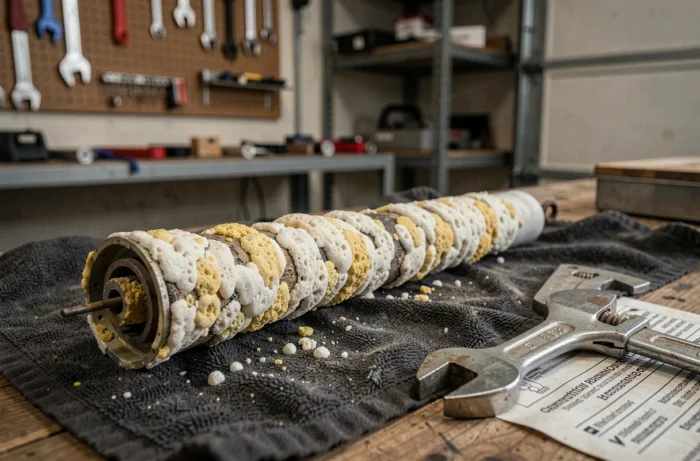
A tenant who calls a plumber for descaling may face a bill much heavier than expected. The technician opens the tank, finds massive limescale buildup on the heating element, and must completely remove it to clean or replace it. This technical shift changes the legal nature of the intervention.
According to Thermor, descaling with removal of the heating element falls under the landlord’s responsibility. The logic is coherent: as soon as an internal component of the device needs to be disassembled, we move from the realm of regular maintenance to that of repair, or even replacement of worn parts.
Aging revealed during the intervention
The most contentious scenario occurs when descaling reveals an advanced state of aging: corroded anode, corroded tank, non-functional heating element. In this case, three points deserve attention:
- The landlord is required to provide decent housing with equipment in good working order. A tank with a corroded tank no longer fulfills this obligation.
- The tenant cannot be held responsible for normal wear of an appliance. Aging is never attributable to the tenant, even if regular maintenance has been neglected (negligence may reduce any potential compensation, but does not transfer the burden of replacement).
- If the technician finds that the appliance needs to be replaced, the tenant should request a written report detailing the state of aging before any decision. This document protects both parties.
Breakdown of the rented hot water tank: who pays for the repair
Aside from descaling, breakdowns of the water heater follow the same logic of distribution. Repairs related to normal wear or aging of the appliance are the landlord’s responsibility. The tenant is only responsible for minor routine repairs and the replacement of accessible consumables (seals of the safety group, for example).
A breakdown occurring on an old appliance, unrelated to a tenant’s maintenance failure, engages the landlord’s liability. The complete replacement of the tank falls into the category of work for which they are responsible, under their obligation to maintain the housing equipment in working order.
When the tenant can be implicated
If the landlord demonstrates that the breakdown is directly due to a failure of regular maintenance attributable to the tenant (safety group never operated, appliance never drained despite lease recommendations), they can request a contribution. In practice, this proof remains difficult to establish, which reinforces the interest for both parties to formalize in writing the interventions carried out.
Checklist to avoid disputes over descaling
- Read the lease in detail: some clauses specify the frequency of descaling and the distribution of costs. An abusive clause (imposing on the tenant the replacement of an aging appliance) remains contestable.
- Keep all maintenance invoices: draining, simple descaling, intervention on the safety group. These documents prove the tenant’s good faith in case of dispute.
- Request a written diagnosis from the technician in case of discovery of aging during a descaling intervention. This report clearly distinguishes what falls under regular maintenance and what falls under replacement.
- Quickly report any anomalies to the landlord (temperature drop, noises, leaks). A late report can complicate the distribution of responsibilities.
The boundary between regular maintenance and heavy repair often hinges on a single technical action: opening the tank and removing the heating element shifts the bill from the tenant to the landlord. Keeping a written record of each intervention remains the most reliable way to resolve any disagreement, regardless of the type of hot water tank installed in the housing.