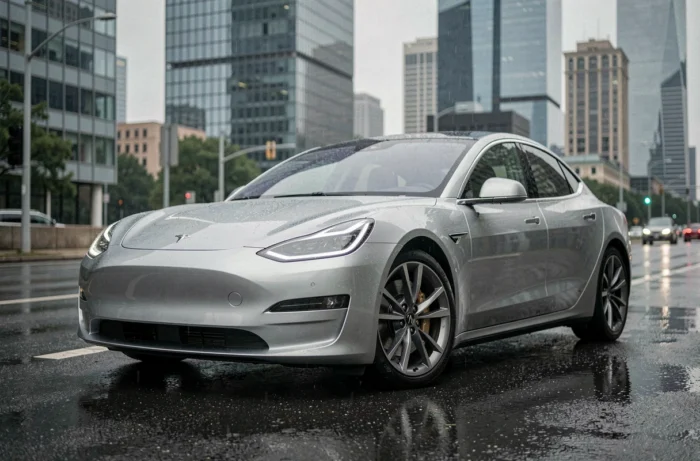
When looking for a new city car at a dealership in early 2024, you come across revamped energy labels, increased penalties, and hybrid ranges that didn’t exist two years ago. The automotive world in 2024 has moved quickly, and not always in the announced direction. With the rise of Chinese manufacturers in the European market, the confirmed decline of diesel, and the real progress of electric vehicles, the usual reference points for buyers have changed.
Euro 7 Standard and Environmental Passport: What Changes for New Vehicles
Most 2024 reports focus on sales figures. There is less talk about what is being prepared on the regulatory side, even though this is precisely what guides manufacturers’ ranges. The Euro 7 standard comes into effect in November 2026, with stricter emission limits on brake particles and tire wear, not just on exhaust gases.
At the same time, a digital environmental passport will be associated with each new vehicle sold in Europe. This document will outline the carbon footprint of manufacturing, the recyclability of components, and the origin of critical materials (lithium, cobalt, nickel for batteries). For buyers, this means an unprecedented level of information at the time of choice.
You can discover the Actu Auto Buzz website to follow these regulatory developments over the months, particularly regarding penalty thresholds and the relevant powertrains.
This regulatory pressure explains why brands like Volkswagen and Stellantis are accelerating the deployment of dedicated electric platforms rather than adapting their old thermal chassis. The cost of Euro 7 compliance on a conventional gasoline engine is becoming comparable to that of hybrid development, which pushes for a direct switch.
Market Share of Electric Cars in Europe: Beyond the Talk of Slowdown
In 2024, there has been much reading about electric vehicles losing momentum. European data tells a different story. For the period from January to July (consolidated data published in August 2026 by a specialized research organization), the share of 100% electric cars in new European registrations is around 21 to 22%, showing a marked increase.
The real issue is the disparity between countries. The Nordic and Benelux markets show electric registration shares exceeding 40%. Denmark surpasses 50%. In France, the growth is real but more modest, driven by purchase incentives and rising fuel prices.
What European Averages Conceal
An average penetration rate hides very different usage realities. In countries where the charging network is dense (Netherlands, Norway), electric vehicles replace the primary household vehicle. In France or Italy, electric vehicles often remain a second urban vehicle, which limits the size of the batteries purchased and thus the average price.
Feedback varies on this point depending on the regions: a driver in a rural area with an 80 km daily commute does not have the same options as an urbanite who drives 15 km per day. Models priced under 30,000 euros with decent range remain rare in the French market, and this is where Chinese manufacturers come into play.
Chinese Manufacturers in France: MG, BYD, and Others on the Ground
MG, BYD, Xpeng, and Jaecoo now regularly appear in monthly French registrations. This is no longer a curiosity from auto shows. In dealerships, one notices higher standard equipment levels than what European brands offer at the same price.
The real competitive advantage of Chinese brands lies in the equipment-price ratio, not just the base price. Central screen, level 2 driving assistance, integrated heat pump: features that are often optional with Europeans are provided as standard.
Network and Resale Value: Points of Caution
Buying a Chinese vehicle in 2024 raises two concrete questions that sales brochures do not always address:
- The after-sales network remains limited outside major urban areas. An MG owner in Limoges or Perpignan may find themselves over an hour away from the nearest service point.
- Resale values in the used market are still difficult to estimate. With little historical data on reliability at 5 years, valuations remain low, which penalizes the total cost of ownership.
- The manufacturer’s warranty (often 7 years) partially offsets this risk, but it is tied to the authorized network, which brings us back to the first point.
Hybrids in 2024: Three Technologies for Three Distinct Uses
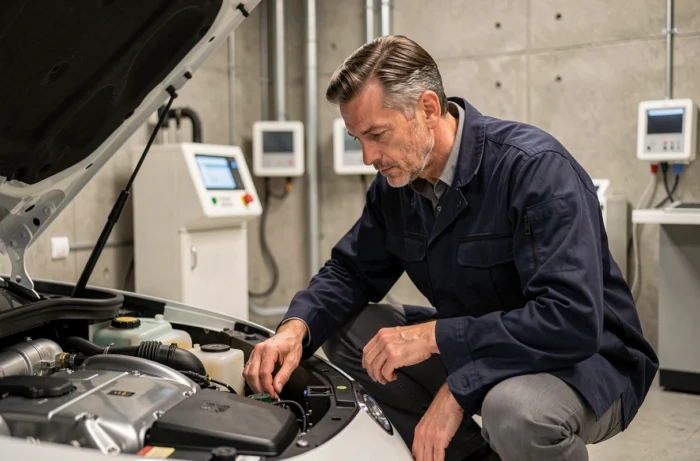
The term “hybrid” encompasses very different mechanical realities, and there is still a lot of confusion in dealerships. Here’s what concretely distinguishes the three available families:
- Micro-hybrid (MHEV): a 48 V starter-generator assists the thermal engine during start-up and acceleration. No pure electric mode. Modest consumption gain, contained price.
- Classic hybrid (HEV): an electric motor coupled with the thermal engine allows for electric driving for a few kilometers at low speed. No charging port. This is the most transparent solution in use.
- Plug-in hybrid (PHEV): larger battery, rechargeable from a socket or charging station. Electric range of several dozen kilometers. Relevant if charged daily, costly if driven only in thermal mode.
The choice depends on daily mileage and the possibility of charging at home or work. A PHEV that is never charged consumes more than a classic HEV due to the additional weight of the battery.
Sales of hybrid models across all categories have increased in France in 2024, confirming that this powertrain serves as a transition for buyers who are not ready to switch to 100% electric. The non-rechargeable classic hybrid remains the best compromise for mixed trips without infrastructure constraints.
The automotive market in 2024 is not just a duel between thermal and electric. Upcoming standards, pricing pressure from Chinese brands, and the diversification of hybrid technologies are reshaping the concrete choices of buyers. The coming months, with the implementation of Euro 7 and the arrival of new models at aggressive prices, will make these decisions even tighter.